Russian queer blogger Hilmi Forks released from prison after serving three-year sentence in pornography case
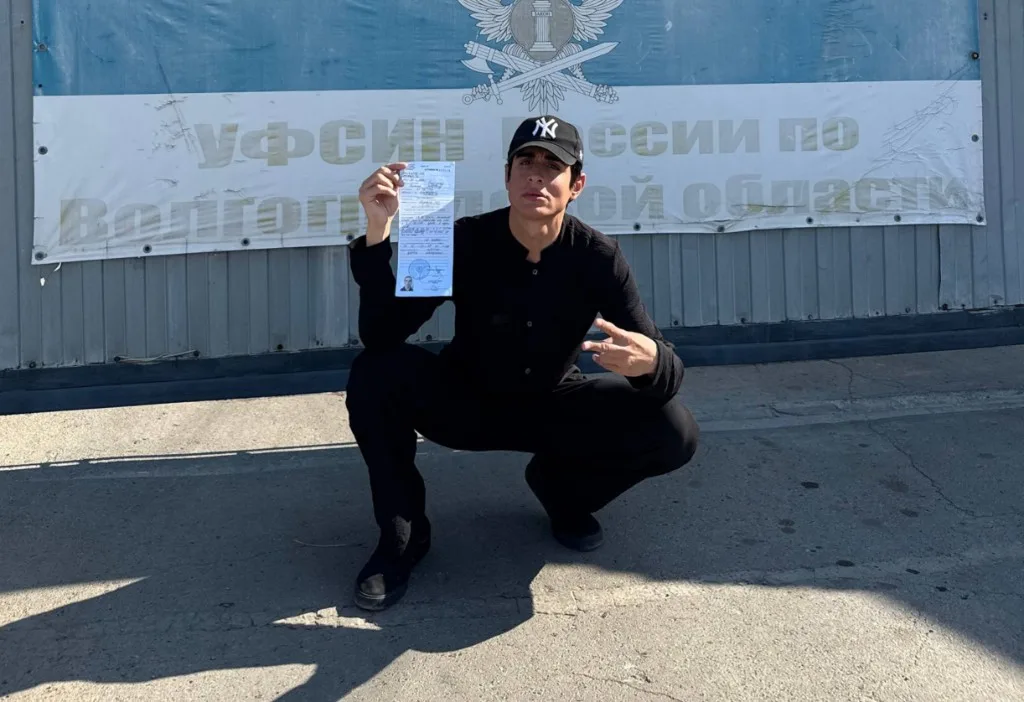
On October 8, 2026, 32-year-old Russian queer blogger Hilmi Forks (legal name Khilmi Oleynik) was released from Penal Colony No. 12 in the city of Volzhsky, Volgograd Region, having fully served his three-year prison sentence. The blogger announced his release on his Telegram channel, sharing a photograph holding his official release certificate outside the regional directorate of the Federal Penitentiary Service (FSIN). “Well, I’m out after three years. Hello to everyone who waited, missed me, and cared. Now I’m with you,” Oleynik wrote.
In December 2023, the Simonovsky District Court of Moscow sentenced Oleynik to three years in a general-regime penal colony under Part 3, Clause “b” of Article 242 of the Russian Criminal Code (illegal production and dissemination of pornographic materials via the internet). He was taken into custody directly in the courtroom. The criminal proceedings were initiated following formal complaints submitted to law enforcement by Ekaterina Mizulina, head of the pro-government Safe Internet League, and State Duma lawmaker Yana Lantratova, who flagged sexually explicit videos Oleynik had posted in his public Telegram channel. In 2024, the Moscow City Court rejected the defense’s appeal and upheld the verdict.
Oleynik served his sentence at Penal Colony No. 12, a general-regime facility for men located in Volzhsky, southern Russia. During the summer of 2026, the Volzhsky City Court twice denied his applications for parole, ruling that “the goal of correcting the convict has not yet been achieved.” In early October 2026, the regional FSIN also published findings from an internal inquiry concerning clips filmed by the blogger on an illicit mobile phone inside the facility back in 2025, noting that the phone was confiscated at the time and disciplinary action was taken. Factoring in pre-trial detention credits calculated under Article 72 of the Russian Criminal Code, his three-year sentence officially concluded in October 2026.
Born in Krasnodar in 1994, Oleynik grew up in an orphanage and rose to prominence in the early 2020s on TikTok and YouTube through flamboyant trash-streaming, provocative stunts, and videos featuring female attire and heavy makeup, often collaborating with blogger Dasha Koreyka. While Russian media and conservative activists frequently labeled him a “transgender blogger,” Oleynik stated in multiple interviews that he did not identify as a trans woman and was not undergoing gender affirmation, framing his persona as theatrical performance and queer self-expression. His high-profile online career drew repeated harassment from conservative groups, physical brawls in public spaces, and administrative detentions in Moscow prior to his criminal conviction.
Uránia consistently monitors criminal and administrative crackdowns targeting the LGBTQ+ community and online creators in Russia. Previously, the journal covered the first criminal convictions handed down under “LGBT extremism” provisions — including the case of Chita queer club owner Tatyana Zorina and the prosecution of healthcare executive Ilya Zhuravlev, as well as censorship charges filed against journalist Karen Shainyan and the detention of femboy candidate Daniil Neonov in Moscow.