Khnumhotep and Niankhkhnum: The First Same-Sex Couple in History?
Or Just Twins? A Detailed Investigation.
Contents
Khnumhotep and Niankhkhnum served at the court of the pharaoh in Ancient Egypt. They held the position of overseers of the royal manicurists. The circumstances of their burial brought them fame: the men were buried together in the same tomb.
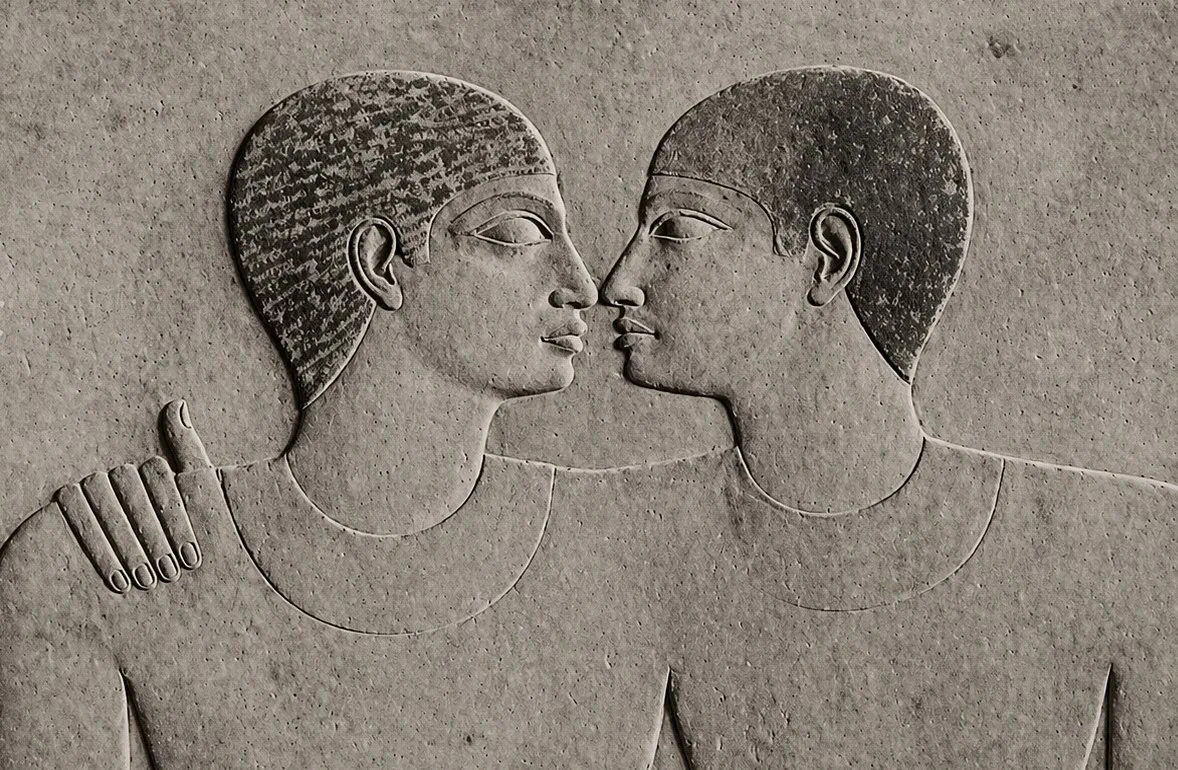
Some researchers consider them to be the first documented same-sex couple in history. In Egyptian art of the time, the intimacy with which men were depicted was only allowed between husband and wife. On the reliefs of the tomb, Khnumhotep and Niankhkhnum hug, hold hands and stand nose to nose (this is how a kiss was conveyed in Ancient Egypt). This became the main argument in favor of their romantic relationship.
This interpretation has opponents. They note that the wives and children of both men are also depicted on the walls of the tomb. According to this version, Khnumhotep and Niankhkhnum could be brothers or twins.
In this article we will look at who Khnumhotep and Niankhkhnum were, when they lived and what exactly is depicted on the walls of their tomb, and then analyze the reliefs one by one, scene by scene.
Opening and construction of the tomb
The tomb was discovered in 1964 in the Saqqara necropolis. Egyptologist Ahmed Moussa found it while clearing the passage to the pyramid of Pharaoh Unas.
After clearing the mine, the chief inspector of Lower Egypt, Munir Basta, went down. He walked along a narrow staircase into a small room for offerings. The walls were covered with inscriptions, which is typical for such structures. The main find was located further.
The stone between the two false doors was carved with men embracing. Previously, archaeologists had not encountered such images in any tomb.
The exact date of construction of the tomb is unknown. In terms of style, it dates back to the second half of the 5th dynasty – the time of the reign of pharaohs Niuserra or Menkauhor. No human remains were found inside.
The tomb was probably built in stages. First, two chambers were cut out of the soft limestone of the northern part of Saqqara. Later, a mastaba was erected above them – a rectangular structure with a flat roof and sloping walls. Usually there was a burial shaft under the mastaba. Construction probably proceeded as funds became available to the owners.
In ancient times, the tomb was plundered. The limestone sarcophagi hidden under the mastaba were damaged. In the late 1970s, German archaeologists restored the complex, and in the 1990s it was opened to visitors.
Epoch and political-religious background
The 5th Dynasty ruled Egypt during the Old Kingdom period from 2504 to 2347 BC. Over these century and a half, the pharaohs consolidated power and restructured religious life. The cult of the solar god Ra became a state priority. Almost every ruler erected temples in his honor.
One of the most notable pharaohs of the 5th Dynasty was Niuserra. He came to power a generation after the construction of the Cheops pyramid. Niuserra built new temples on a large scale, and under him the cult of Ra reached its peak.
Khnumhotep and Niankhkhnum lived and served against the backdrop of this religious upsurge and active state building.
Social status and titles
Hieroglyphic inscriptions call Khnumhotep and Niankhkhnum “overseers of the manicurists of the royal palace.” This profession was denoted by the hieroglyph of an animal’s paw with outstretched claws. Men were responsible for caring for the hands of the pharaoh and were part of the circle of those close to him who were allowed to touch the ruler.
Preparing the king for public appearances required the work of many specialists. Servants were assigned to workshops with their own management. In addition to manicurists, officials with the title “keeper of the headdress” served at the court and were responsible for the pharaoh’s wigs and scarves.
Khnumhotep and Niankhkhnum also bore other titles: “keeper of secrets”, “familiar of the king”, “confidant of the king”, “guardian of the king’s property”, “beloved of his master”, “priest of Ra”, “purifier of the strong places of Niuserra” (cleaning priest) and “he who purifies the king”.
They were part of the circle of high-ranking courtiers. Their probable boss was Ptahshepses – first the “guardian of the headdress”, and then the vizier who supervised the construction of the pyramids. His tomb also contains images of Khnumhotep and Niankhkhnum.
A separate tomb was a rare privilege. Such structures were erected on the instructions of the pharaoh or with the permission of an influential priest. This required significant funds and served as a sign of high status.
Both men were married and had large families. Khnumhotep’s wife was named Henut; they raised at least five sons. Niankhkhnum was married to Khentikawes; they had three sons and three daughters.
The exact ages and order of death of the men are unknown. However, signs indicate that Khnumhotep died first. His name has epithets, he is depicted with a ceremonial beard, and in the feast scene only Niankhkhnum’s wife is shown nearby. The decoration of the tomb was probably completed by Niankhkhnum.
Kinship hypothesis: “brothers” and “twins”
In 1979, one of the first researchers of the tomb, Munir Basta, noted:
“This scene [of the men embracing] is repeated on the other two walls… The significance of the discovery of this tomb is due to this unique scene. The inscriptions in the tomb do not give us any answer to the question of the relationship between these two dead. Were they brothers? Were they father and son? Or were they two officials of the royal palace who enjoyed a warm friendship during life and wanted to preserve it after death in the afterlife?
Proponents of kinship rely on how closely the men are depicted in the reliefs. Oxford University professor John Baines suggested in his 1985 paper “The Egyptian Twins” that they were twins. According to him, in Ancient Egypt there was a taboo against twins. To get around the ban, they were portrayed with exaggerated affection, uniting them into one social personality.
There is no direct evidence of twins from the Old Kingdom era. Baines relied on a New Kingdom stela (created about 1000 years later) depicting Suti and Horus. Baines considered them “undoubted twins”:
“The stele of Suti and Horus from the reign of Amenhotep III contains what appears to be the only explicit reference to twins or multiple births from the era of dynastic Egypt… The unusual language of this stele at first seems to confirm their “undoubted twinship”, since they are called snw (“brothers”), and Horus says: “he came with me from the womb on the same day.”
The language of the Suti and Horus inscriptions allows for different interpretations. There is no direct indication of relationship in the text. Egyptologist Jean Revez proved that the word “sn” (often translated as “brother”) possessed immense semantic fluidity. It meant not only blood kinship, but also political or emotional complementarity – an “alter ego” or a colleague of equal status. Moreover, in ancient Egyptian love poetry, this term was universally used to designate a passionate lover or spouse. The phrase about leaving the womb on the same day may emphasize their social and spiritual equality. Historian Greg Reeder strengthens this argument by emphasizing that the phrase about leaving the womb on the same day places the emphasis not on biological twinship, but on their absolute social equality and equal rights, which deprives Baines’ hypothesis about “bypassing the twin taboo” of solid ground.
Among modern researchers of the tomb there are also Egyptologists who openly talk about their homosexuality: Greg Reeder and Richard Bruce Parkinson. They interpret the relationship between Niankhkhnum and Khnumhotep differently.
Parkinson supports the twin hypothesis. The names of men given at birth and associated with the god Khnum indicate consanguinity. Parkinson notes the reference to the song of the “two divine brothers” in the feast scene. This may be a reference to Horus and Set. Parkinson adds that Seth was sexually attracted to Horus, which leaves room for queer interpretations. In his view, regardless of kinship, these images remained powerful symbols of male intimacy and could be perceived through a queer lens in antiquity.
Greg Reeder challenges Baines’ theory of a “single social personality”. In new parts of the tomb of Vizier Ptahshepses, Niankhkhnum and Khnumhotep are shown together, but in another scene Khnumhotep walks alone. In the old part of the tomb of Ptahshepses, Khnumhotep is depicted alone in the role of a barber, before receiving the post of royal manicurist. This proves that they were also perceived separately.
Professor David O’Connor hypothesized that the men were Siamese twins, and artists conveyed their physical connection through the language of emotion. Reader refutes this version. Analysis shows that Khnumhotep died first. The living Niankhkhnum completed the decoration of the tomb: Khnumhotep has the epithet “great god” and a ceremonial beard, which Niankhkhnum does not have. The conjoined twin would have bled to death within hours of his brother.
The “doubles” model: equal in status
The scenes in the tomb look too intimate for blood relatives. Egyptologist Jean Revez proposed that men be considered symbolic “doubles” – people equal in status, influence, and views. The word “sn” could mean friend, lover, colleague or associate. In this context, we are talking about spiritual closeness, not kinship, and “sn” is understood as “alter ego.”
Niankhkhnum and Khnumhotep bore the same title. On the reliefs they are shown as equals: each receives the same offerings, no one dominates. Equality is rare in Egyptian burials; Usually status was emphasized by the size of the figures or location.
First same-sex couple?
Greg Reeder believes that male relationships should be studied through iconography, the visual language of ancient Egyptian art. He is supported in this by researcher Thomas A. Dowson, who criticizes classical Egyptology for its double standards and the imposition of heteronormativity on ancient artifacts. According to Dowson, if a man and a woman are depicted on a relief, orthodox science automatically categorizes them as spouses, but if two men are depicted in the exact same poses, it demands irrefutable proof of their relationship, defaulting to calling them “brothers.”
He draws on Nadine Sherpion’s study Conjugal Feeling and Image in the Old Kingdom (1995). Sherpion analyzed images of couples from the 4th, 5th, and 6th dynasties and concluded that nowhere in Egyptian art was male affection expressed so openly. The poses, gestures and compositions of Niankhkhnum and Khnumhotep are not just signs of sympathy. They exactly replicate the “conjugal syntax” (marital canons), which in Egyptian art was strictly reserved exclusively for traditional opposite-sex couples.
Having wives and children was the norm for powerful officials in Egypt. However, Sherpion notes the almost complete absence of wives on the walls of the tomb. Each of them appears three or four times, while the husbands are depicted about thirty times. Sherpion summarizes: “Psychologically, there was no place for them [the wives] in this tomb, especially in the images where the men embrace each other.”
In scenes of physical intimacy, men are depicted with each other. There are no scenes with wives in the offering hall. This indicates the main semantic core of the tomb – the connection between Niankhkhnum and Khnumhotep.
Let’s look at the tomb one by one.
Entrance
On both sides of the entrance are names and the same titles: “chief manicurist”, “acquaintance of the king”, “confidant of the pharaoh” and “overseer of manicurists in the palace”. On the front wall there are almost identical reliefs of Niankhkhnum and Khnumhotep.
Behind the entrance is a hunting scene in the swamps – a symbol of fertility and life after death. Niankhkhnum hunts birds; children are watching him, and his wife is holding a lotus flower. Opposite, Khnumhotep strikes two fish with a spear; His wife with a lotus flower and children stand nearby.
Near the second doorway, the transportation of statues of the deceased is depicted. A sculptural composition stands out where men walk holding hands. This motif was usually used to depict married couples.
A similar statue of the couple from the Nikau-Khnum chapel in Giza is kept in the Leipzig Museum. It shows a man and a woman also holding hands.
On the eastern wall of the entrance hall, Niankhkhnum and Khnumhotep sit in close embrace and greet the bearers of gifts. Niankhkhnum is located in front, and Khnumhotep is behind, in the place that was usually occupied by the woman in opposite-sex couples.
Similar iconography of a heterosexual couple is found on the sacrificial altar in the depths of the tomb. It belonged to Niankhkhnum’s son, Hamra, and his wife Tzheset. Hamre is depicted in front, and Tzheset is behind, her hand hugging her husband’s right shoulder, repeating the gesture of Khnumhotep.
The text of the decree before Niankhkhnum and Khnumhotep prohibits wives and children from interfering with donations. The care of the tomb must be provided by priests, and gifts are intended exclusively for men and their parents. In this context, Niankhkhnum and Khnumhotep are presented as a married couple.
Below the seated figures are five rows of images. The third row shows ten figures, with a man and a woman walking in front, possibly the parents of the owners of the tomb. Niankhkhnum and Khnumhotep close the series. They hold hands: Niankhkhnum leads his partner. The woman from the first couple and Khnumhotep are the only characters who hold their partner’s hand, rather than lifting it to their chest. The viewer sees a visual juxtaposition of heterosexual and homosexual couples.
On the southern wall of the entrance hall, Niankhkhnum again leads Khnumhotep by the hand into the interior.
This composition repeats scenes from other tombs. In the tomb of Mereruka, he also leads his wife Uatethethor deep into the tomb to the marital bed.
First vestibule, courtyard, second vestibule
The first vestibule is decorated with scenes of bread baking, beer brewing, goat herding, ship building and bird catching. On the east wall is a legal text.
The courtyard connects the vestibule with the mastaba and the rock part of the tomb.
The second vestibule contains the names, titles and portraits of the men. The lintel is decorated with a scene of a livestock census. On the side walls, each man is shown with his wife among the gifts.
Above the entrance to the rock section, the names of Niankhkhnum and Khnumhotep are written as a single name. They contain a hieroglyph of a vessel associated with the potter god Khnum, the patron saint of the Nile floods.
Both names include the name of the creator god Khnum (such names are called theophoric). Niankhkhnum means “God Khnum lives” and Khnumhotep means “Khnum is pleased.” The word “khnum” itself was translated as “connected” or “connecting”, and later came to mean partners and comrades. The single entry of names could be a play on words and mean “together in life and in death.” It is unknown whether men received these names at birth or chose them later.
Below the inscription, men sit among the offerings. On the left, Khnumhotep smells a lotus. In the 5th Dynasty, women were depicted this way almost exclusively (only three exceptions are recorded). The wives and Khnumhotep smell the lotus in the tomb. Probably, the creators of the tomb deliberately assigned him the role traditional for a wife.
Front chamber and offering room
In the southern part of the rock chamber there is a feast scene with musicians, singers and dancers. The masters made changes to it. Behind Niankhkhnum his wife Khentikawes was originally carved. She sat at the same level with him and hugged him. The tomb’s creators removed her figure, but left fingerprints on her husband’s shoulder. As a result, Niankhkhnum and Khnumhotep became the only guests at their feast. There was initially no free space for his wife behind Khnumhotep’s back.
At the entrance to the sacrificial room is the first truly intimate image. Niankhkhnum supports his companion’s forearm, and Khnumhotep hugs his shoulder. Gesture dialogue conveys deep intimacy. There are no wives in the scene, only children are shown.
Similar compositions are found in Giza: in the tomb of Kaya, the wife hugs her husband next to the children; in the tomb of Uhemka, the wife holds her husband by the shoulder and forearm. Men repeat marital gestures.
In the sacrificial room there were two false doors – symbolic portals for the souls of the dead. The false door of Niankhkhnum is destroyed by marauders.
A hug scene was cut between the doors. Niankhkhnum supports his companion, and Khnumhotep hugs him. They are facing each other. The composition resembles a relief from the tomb of the spouses Nefer and Kha-Hai.
The most intimate scene is carved on the inside of the entrance column, opposite the false doors. The men stand alone. They are depicted closer than husband and wife in other tombs. The knots of their belts touch, and their faces are nose to nose. The artist probably depicted a kiss: in the Old Kingdom this word was denoted by the hieroglyph of noses touching.
Whatever the biological connections between Niankhkhnum and Khnumhotep, the language of the tomb indicates their deep affection. The visual structure of these scenes is based on the tradition of depicting married couples. This iconography goes beyond what was considered the norm during the Old Kingdom, and makes this monument a unique testimony to alternative connections in Egyptian society.
Literature and sources
- Ranke H. Die ägyptischen Personennamen. Bd. 1: Verzeichnis der Namen. 1935.
- Dowson T. A. Queering Sex and Gender in Ancient Egypt. 2008.
- Revez J. The metaphorical use of the kinship term sn “brother”. 2003.
- Reeder G. Same-Sex Desire, Conjugal Constructs, and the Tomb of Niankhkhnum and Khnumhotep. World Archaeology. 2000.
- Reeder G. Queer Egyptologies of Niankhkhnum and Khnumhotep. // Sex and Gender in Ancient Egypt. Edited by Carolyn Graves-Brown. 2008.
- Simpson W. K., Moussa A. M., Altenmüller H. Das Grab des Nianchchnum und Chnumhotep (Book Review). Orientalistische Literaturzeitung. 1982.
- Parkinson R. B. The first gay kiss?. 2019.