Divine Homosexuality in the Ancient Egyptian Myth of Horus and Seth
\"...how beautiful your buttocks are, how strong! Spread your legs,\" Seth said to Horus.
Contents
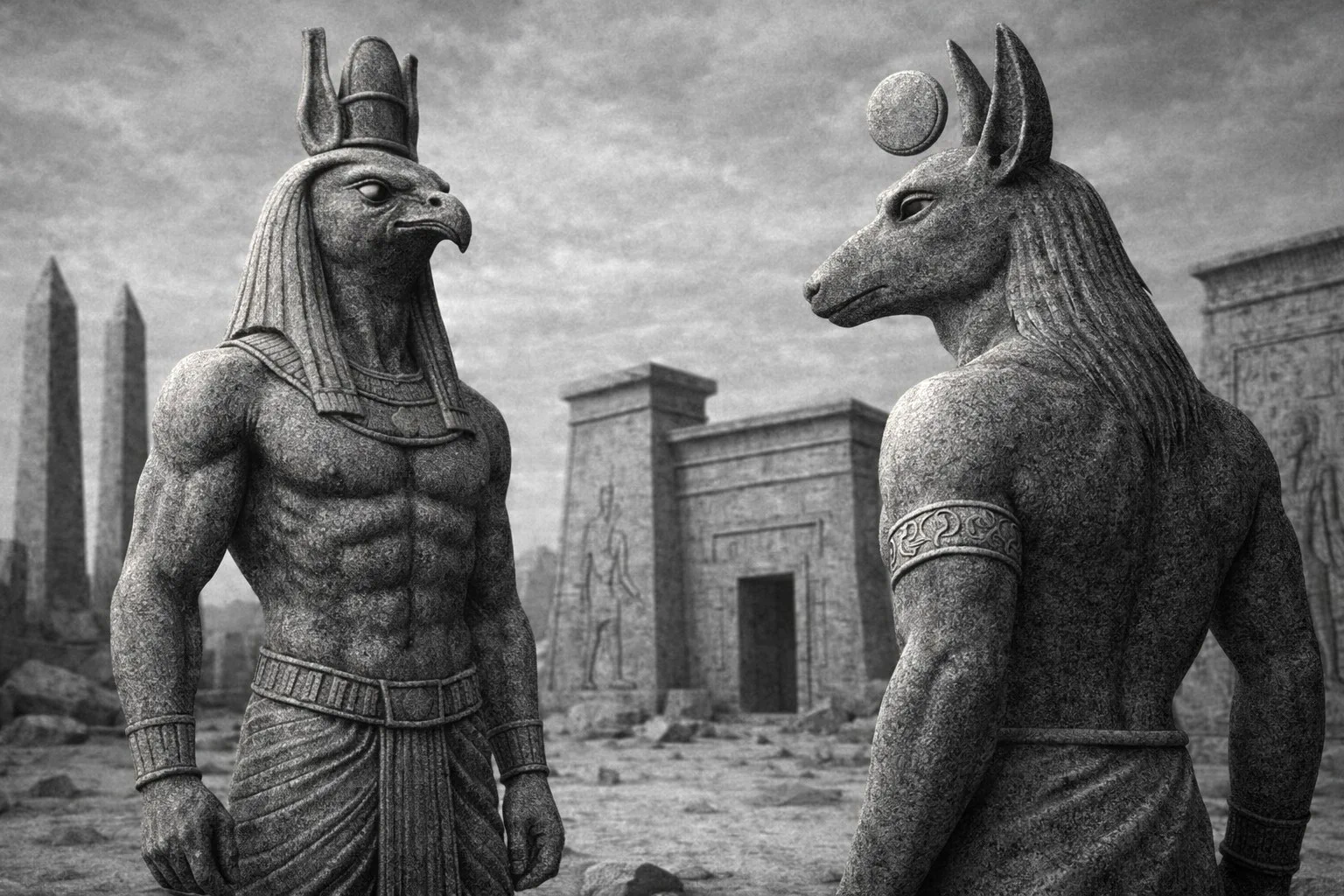
One of the early Egyptian myths describes the confrontation between Set and his nephew Horus. In one episode, Seth tries to have sexual intercourse with Horus in order to humiliate him and confirm his superiority. Horus acts differently: he intercepts Seth’s sperm with his hand and throws it out.
For a modern reader, such a plot may seem unexpected. Why did the ancient priests include a scene associated with male divine homosexuality in a religious myth? To understand the meaning of this episode, you need to consider who Horus and Set were, what their enmity was, and what significance the Egyptians attached to such actions in myths.
Who are Horus and Set
Horus is one of the main gods of the ancient Egyptian tradition. He was depicted as a falcon or a man with the head of a falcon. The name Horus is usually translated as “exalted” or “distant.” This meaning was correlated with the falcon’s ability to rise into the sky and thus emphasized the divine nature of God.
Since ancient times, the cult of Horus has been associated with royal power. The pharaohs perceived him as their heavenly patron.
According to myths, Horus was the son of Osiris and nephew of Set. After the death of Osiris, Horus had to avenge his father and defend his right to the Egyptian throne. In the decisive duel, he defeats Seth and confirms this right.
Seth also belonged to the most ancient Egyptian gods. He was depicted in the guise of an unusual animal with an elongated muzzle and short ears. Perhaps the prototype of this creature was an aardvark.
In myths, Set appears as an aggressive and cruel deity. He personifies chaos, destruction, desert and foreign lands, that is, everything that lies beyond the fertile Nile Valley.
In various stories, Seth harasses goddesses and tries to subjugate Horus. This corresponds to its mythological function. For the Egyptians, such actions expressed the nature of Set as the bearer of a hostile, indomitable force. At the same time, chaos was not considered an absolute evil. It was understood as a necessary part of the world order, without which balance is impossible.
Seth’s image has changed over time. In the early texts, he does not yet look like the embodiment of absolute evil: rather, he is a dangerous and insidious rogue. In later eras, he was increasingly associated with foreigners and external enemies of Egypt. Then he finally turned into a symbol of unrest and destruction.
In ancient sources, Horus and Set often appear as a couple. They were called “Two Lords”, “Two Gods”, “Two Men”, as well as “Two Rivals” and “Two Opponents”.
These formulas express one of the key ideas of Egyptian mythology. The world is kept in constant tension between order and chaos. Horus and Set represent precisely this confrontation. Their struggle does not destroy the world order, but, on the contrary, shows how it is kept in balance.
History of the myth “The Adventures of Horus and Set”
The earliest versions of the myth of the enmity of Horus and Set go back to the pre-dynastic period, that is, to the time before the appearance of the pharaohs and a unified Egyptian state. This early version featured only two characters, Horus and Set. They were irreconcilable rivals, constantly fighting and inflicting severe injuries on each other.
Towards the end of the Old Kingdom the plot changed. Osiris was introduced into it – the brother of Set and the father of Horus. According to the new version, Osiris died at the hands of Set, and then Set tried to eliminate his son in order to seize supreme power among the gods. This cycle of myths is known as The Adventures of Horus and Set. Other names are also found in the sources: “Dispute between Horus and Set,” “Duel,” and “Litigation.”
The earliest written evidence of the struggle between these gods is contained in the Pyramid Texts, a collection of magical formulas and religious hymns that were carved on the walls of royal tombs at the end of the Old Kingdom. Later, similar motifs appear in the Sarcophagi Texts and in the Book of the Dead, a large collection of funeral spells.
Detailed versions of the myth appeared during the Middle Kingdom, from about 2040 BC. The most famous edition dates back to the end of the New Kingdom (around 1160 BC). It is preserved on the Chester Beatty I papyrus. The text is written in hieratic, a simplified and quick form of hieroglyphs for everyday writing.
The papyrus was found in Deir el-Medina, a settlement near ancient Thebes. There lived artisans who created tombs and paintings for the pharaohs in the Valley of the Kings.
The translation and first edition of the Chester Beatty I papyrus in 1931 was prepared by British Egyptologist Alan Henderson Gardiner. The name of the ancient Egyptian author of the text is unknown.
The Greek writer Plutarch, who lived in the 2nd century AD, also left a detailed retelling of this story.
General content of the myth
Osiris ruled Egypt as king. His brother Set was jealous of him and decided to kill him to take the throne. He conspired and invited Osiris to a feast. There, Seth invited his brother to lie down in a richly decorated chest, made exactly to his measurements. As soon as Osiris was inside, Seth slammed the lid and threw the chest into the Nile. Thus Osiris died.
His wife Isis went in search of the body. When she found him and tried to bring Osiris back to life, Set intervened again: he stole the body, cut it into fourteen pieces and scattered it throughout Egypt.
Isis began searching again and collected almost all the remains. According to Plutarch, she did not find only the genital organ: it was allegedly swallowed by fish. However, in the Egyptian tradition there was another version of the plot – Isis found all the parts of the body. With the help of spells, she briefly revived Osiris, and this was enough to have sexual intercourse with him and conceive Horus.
Horus was born weak and premature; the legends also say that he had sore legs. From an early age, Seth tried to get rid of his nephew. In one of the stories, Horus almost died from a scorpion bite, but he was saved by Ra, the god of the sun, and Thoth, the god of wisdom.
Now the throne should rightfully pass to Horus. Seth, however, argued that the young god was too inexperienced to rule, and demanded that he be recognized as king. At the request of Isis, the gods held a trial. The chief judge was Ra, and Thoth kept a record of the meetings.
The litigation continued for eighty years. Some gods supported Horus, others – Set, and Ra himself more often leaned towards Set. To end the dispute, the gods turned to the goddess of wisdom Neith. She made the final verdict: the throne should belong to Horus. At the same time, Neith tried to pacify Seth and promised to marry the goddesses Anat and Astarte to him.
But even after this, Ra continued to doubt, and the meetings were postponed again and again. At Seth’s request, Isis was prohibited from participating in the process, and Ra agreed with this. Isis did not obey. She changed her appearance, bribed a guard named Anti, and entered the courtroom. Taking the form of a young woman, she seduced Seth, and he himself admitted that the kingdom should rightfully go to her son. When Isis revealed who she was, Seth was disgraced. After this, the gods decided to crown Horus, and Anti was punished for treason.
Seth, however, did not resign himself and proposed a new test. Both gods had to turn into hippopotamuses, dive into the Nile and hold their breath underwater for three months. The winner was the one who could survive the longest.
Fearing for her son, Isis made a magic spear and threw it. First she mistakenly wounded Horus himself, then she hit Seth. When Seth began to beg for mercy, Isis took pity and pulled out her spear. Horus, outraged by her condescension, beheaded his mother in a rage. Isis immediately turned into a headless stone statue. Thoth brought her back to life by placing the head of a cow on her body.
After this, Horus left the meeting of the gods and went into the desert. There Seth overtook him, tore out his eyes – according to another version, only his left eye – and buried them in the ground. The goddess Hathor took pity on Horus, prepared a healing remedy from the milk of an antelope, and his sight returned, although the eyes themselves were never found.
Exhausted by this enmity, Ra demanded that Horus and Set at least sit at the same banquet table. But the conflict did not end there.
The homosexual part of the myth
Set did not give up the fight and made a new attempt to humiliate Horus. He invited his nephew to spend the night at his house, and Horus agreed. That night, Seth tried to rape him. In Ancient Egypt, such a scene was understood as an attempt to humiliate an opponent and deprive him of the right to power. At the same time, Egyptians stigmatized exclusively the passive (receiving) participant, as his role symbolized submission, weakness, and feminization. The active (penetrating) male role played by Set was not subjected to moral condemnation in itself. Set’s virility and aggressive sexuality, although destroying the boundaries of normativity established by the cosmic order of Maat, were recognized as a necessary part of natural balance.
Horus escaped violence: he caught Seth’s sperm with his hands and took it to Isis.
Isis, having learned about what had happened, was horrified. She decided to “purify” her son, cut off his hands and threw them into the Nile, and then restored them with the help of magic. Afterwards, she masturbated Horus, collected his seed, and tricked her into spreading it on a salad – Seth’s favorite food. Suspecting nothing, Seth ate the dish and found himself “pregnant” from Horus.
Later, Seth had a shining disk on his forehead, similar to the moon. He tried to get rid of it, but the god of wisdom Thoth grabbed this disk and made it a symbol of the night luminary.
Here is how it is described in the sources. In the Kahun Papyrus, created during the Middle Kingdom, Set persuades Horus to spend the night with him and praises his butt (in the original, this phrase sounds like nfr wy pḥ.wy.ky). In this version of the myth, Set tries to seduce his nephew not only out of a thirst for political domination, but also due to overt physical attraction — the text notes that this action was “sweet to his heart.” Historian Parkinson considers this episode one of the earliest examples of flirtation:
“The Majesty of Set said to the Majesty of Horus: How beautiful are your buttocks, how strong! …Spread your legs…
And the divine Horus said: “Be careful, I will tell you about this!”– Kahuna Papyrus, dialogue between Set and Horus
After this, Horus complained to his mother about Set’s harassment, and Isis explained to him how to avoid violence and at the same time preserve Set’s seed.
“And she said to him: ‘Beware! Don’t raise this issue with him! When he talks about it again, then tell him: ‘This is too painful for me, because you are heavier than me. My strength [backside] will not withstand your strength [erection]…” When he gives you his strength, put your fingers between your buttocks. … Then he will experience great pleasure. [Save] this seed that will come out, and do not let the sun to see him…""
– Kahuna Papyrus, dialogue between Set and Horus
Isis then applied the seed of Horus to Set’s favorite salad. When Seth, confident of his victory, began to boast to the gods that he had captured his nephew, the gods decided to test both.
The seed of Set responded to their call from the water, and the seed of Horus appeared on Seth’s forehead in the form of a golden disk. God Thoth took this sign for himself and made it a symbol of the moon.
Another source is the Pyramid Texts, dating from the Fifth Dynasty. This fragment was published only in 2001 after the discovery in the pyramid of Pharaoh Pepi I. Here Set and Horus are described as equal participants in sexual intercourse: both are the active party:
“If Horus deposited his seed in Set’s ass, it was because Set deposited his seed in Horus’s ass!”
– “Pyramid Texts”, Fifth Dynasty
A later version of the myth dates back to the New Kingdom, towards the end of the 20th Dynasty, around 1160 BC. It describes this episode differently:
“Seth said to Horus: “Let’s go and spend a pleasant hour in my house.”
Horus replied: “With pleasure, with pleasure.”
When evening came, a bed was made for them and they lay down. At night, Seth tensed his penis and placed it between Horus’ thighs. Horus put his hands between his thighs and caught Seth’s seed."– Late version of the myth, New Kingdom (end of the 20th dynasty)
After this, Horus went to his mother and showed her the seed:
“Help me! Come see what Seth did to me." And he opened his palm and showed her the seed of Seth. Screaming, she took the weapon, cut off his hand and threw it into the water, and then used a spell to create a new hand for him to replace it. Then Isis helped Horus ejaculate the seed and spread it on the salad, which was Set’s favorite vegetable, after which she gave it to him to eat.”
– Late version of the myth, New Kingdom (end of the 20th dynasty)
When Set appeared before the council of nine supreme gods – the Ennead – he declared that he had mastered Horus and performed “the act of a man [warrior]” (in the Egyptian original - kAt-aHAwtj, “labor/deed of a husband-warrior”). As historian Richard B. Parkinson explains, the use of this specific term shows how this act was used by Seth to demonstrate his dominant masculinity in contrast to Horus’s youth, weakness, and passivity. The gods became furious: they shouted, spat in Horus’s face and expressed indignation.
Then the gods called upon the seed and the deception was revealed.
At the end of the myth, Osiris intervened, having previously remained silent. He accused the gods of weakness and threatened to send famine and disease to Egypt from the afterlife, where he now ruled, if they did not recognize the rights of Horus. After this threat, the gods ruled in favor of Horus and recognized him as the legitimate heir to royal power.
Seth was not rejected. He was placed next to the solar god Ra and called “the one who roars in the sky.” From that moment on, he established himself as a deity of storm and thunder: terrible, but revered.
Interpretations of the homosexual episode
Previously, some historians considered the episode of Seth’s attack on Horus to be comic and obscene. Alan Henderson Gardiner, a translator of Egyptian myths, called it an example of “frivolous literature.” The Puritan view prevented him from seeing such stories as a serious part of religion. He classified the beheading of Isis, the mutilation of Horus, the damage to the eyes and the homoerotic behavior of Seth as material of dubious value, which, in his opinion, could be read to peasants at funeral ceremonies.
Later views changed. Historians Henry Frankfurt and Adrian de Bouck saw dualism in the myth as the basis of the Egyptian worldview. In their opinion, the Egyptian world was built on opposites: male and female, heaven and earth, order and chaos. Horus and Set embodied these forces, and their struggle symbolized the constant clash of antagonists, in which order ultimately wins and Horus asserts his dominance.
In 1967, historian Hermann te Velde proposed a more complex interpretation in his book Seth, God of Confusion. He connected the myth with ancient times, when religious ideas and rituals took shape. Horus represents royal order, and Set represents instability, rage and madness. Seth’s sexuality, according to Welde, is aimed at both men and women, and his testicles – carriers of sexual energy – symbolize destructive cosmic forces and social upheavals. The victory of Horus does not completely destroy Set. Their combination, on the contrary, expresses the harmony of opposites, and the pharaoh is thought of as a figure that unites both forces.
Historian Wolfhart Westendorf has proposed a different explanation. He pointed out that the Egyptians considered semen to be poison if it entered the body inappropriately. However, Seth, who swallowed the seed along with the salad, did not die. Therefore, according to Westendorf, what was important for the gods in this episode was not the seed itself, but the status of the participant in the act: the one who occupies a “female” position cannot lay claim to royal power.
Historian Dominic Montserrat drew attention to the equality of opponents. Horus and Set are adult gods of the same rank. Horus agrees to intimacy, but avoids anal intercourse, and Seth openly shows attraction. Montserrat makes a cautious conclusion: male attraction to a man was probably not taboo in Egypt, but submission in anal sex was considered a disgrace. They knew about such relationships and could participate in them, but the issue of status remained decisive.
Of particular importance in the myth is the salad on which Isis applied the seed of Horus. In Egyptian culture, this plant was associated with male fertility. Through this motive, Seth is symbolically “impregnated” and, in a certain sense, transferred to the female role, which finally deprives him of the right to supreme power.
At the same time, the myth retains internal contradiction. For Horus, the threat of being forced into a subordinate position was shameful, but it is his seed within Set that gives birth to the divine lunar symbol.
Symbolism of power in myth
From the earliest stages, the myth of the struggle between Horus and Set was associated with royal power in Egypt. The German Egyptologist Kurt Heinrich Zethe believed that this legend reflected the struggle between Upper and Lower Egypt. However, later research shows that it was probably not about the confrontation between two parts of the country, but about the long-standing rivalry between the cities of Nekhen and Nubta.
Archaeological evidence indicates that around 3500 BC, the inhabitants of these centers revered Horus and Set as their main patrons. After Nekhen’s victory, the balance of power changed: his rulers subjugated Egypt and declared the country under the protection of Horus. The first kings began to include the name of this deity in their titles. Among them are Khor, Ni-Khor, Hat-Khor, Pe-Khor and others.
Over time, the Egyptians began to perceive the country as a single whole, consisting of “Two Lands” – Upper and Lower. The symbol of unification was the crown of Pharaoh Pschent (pꜣ-sḫm.ty), which connected the white and red crowns. The pharaoh was thought of as the embodiment of the “Two Fighters” – Horus from Nekhen and Set from Nubt.
This juxtaposition expressed the ritual union of opposing forces. Already under the rulers of the 1st dynasty, the title “Horus-Set” appeared. In this pair, Horus denoted order and harmony, and Set denoted destructive energy directed against the enemies of Egypt.
Eye of Horus and Testicles of Seth
In ancient Egyptian mythology, light and sexuality were often represented as two opposing forces. Already in early texts this opposition was expressed by two images: the Eye of Horus and the Testicles of Set. When one of these symbols became the center of meaning, the other receded into the background.
The Eye of Horus was associated with the moon and its phases. In the priestly tradition, it signified light, renewal and continuous rebirth. It was contrasted with the Testicles of Seth – a sign of chaotic, uncontrollable sexuality, as well as human passions and desires. Such energy was considered potentially useful, but only if controlled and subject to order.
Seth himself was also correlated with this symbolic series. In myths, he shows attraction to both women and men. His testicles were associated not only with sexual power, but also with the destructive manifestations of nature – thunder, storms and hurricanes. In a broader sense, they could denote rage, violence and social upheaval.
Some of these ideas are recorded in the Pyramid Texts:
“When no rage had yet arisen.
When no scream had yet arisen.
When no dispute has yet arisen.
When no turmoil has yet arisen.
When Horus’s eye had not yet turned yellow.
When Seth’s testicles were not yet powerless."– “Pyramid Texts”
“Horus fell for his eye, Set suffered for his testicles.”
– “Pyramid Texts”
“Horus fell because of his eye, the Bull disappeared because of his testicles.”
– “Pyramid Texts”
“… so that Horus may be cleansed of what his brother Set did to him, for Seth to be cleansed of what his brother Horus did to him.”
– “Pyramid Texts”
God Thoth as the son of Horus and Set
In Egyptian tradition, the origin of the Moon was also associated with the myths of Horus, Set and Thoth. According to one version, the lunar disk emerged from Seth’s forehead after he swallowed a salad soaked in the seed of Horus. The seed flared up and turned into a golden disk shining on Seth’s head. Thoth, the god of wisdom, took this disc and put it on as a crown.
This motif goes back to the Pyramid Texts. It says either that Thoth came from Set, or that the Moon was taken directly from his forehead. Later, in the Sarcophagi Texts, Thoth addresses Osiris and calls himself “the son of his son, the seed of his seed.” This formula emphasizes his descent from Horus and makes him the grandson of Osiris.
In other sources, Thoth is called “the son of the Two Rivals” or “the son of the Two Lords who came out of the forehead.” This unusual birth was understood as a sign of reconciliation. Thoth turned out to be the son of two gods at once and therefore acted as a mediator capable of ending their enmity.
There was another version of the myth. In it, Seth, during a duel, tears out both eyes or only the left one from Horus. An eye thrown to the ground breaks into six pieces. Thoth collects them, heals the eye and returns it to Horus. The meaning of this episode is the restoration of cosmic order, disrupted by the struggle. Harmony returns when Horus regains his eye, and Set receives his lost powers. The Pyramid Texts put it this way:
“Bearers of Horus, who loved Teti, for he brought him his Eye! The bearer of Set, who loved Aunt, for he brought him his testicles! Bearer of Thoth who loves Teti! Because of them, the Double Aenead shook! But the bearers that Teti loves are the bearers to the table of offerings!”
– “Pyramid Texts”
Horus and Set in the tomb of Niankhkhnum and Khnumhotep
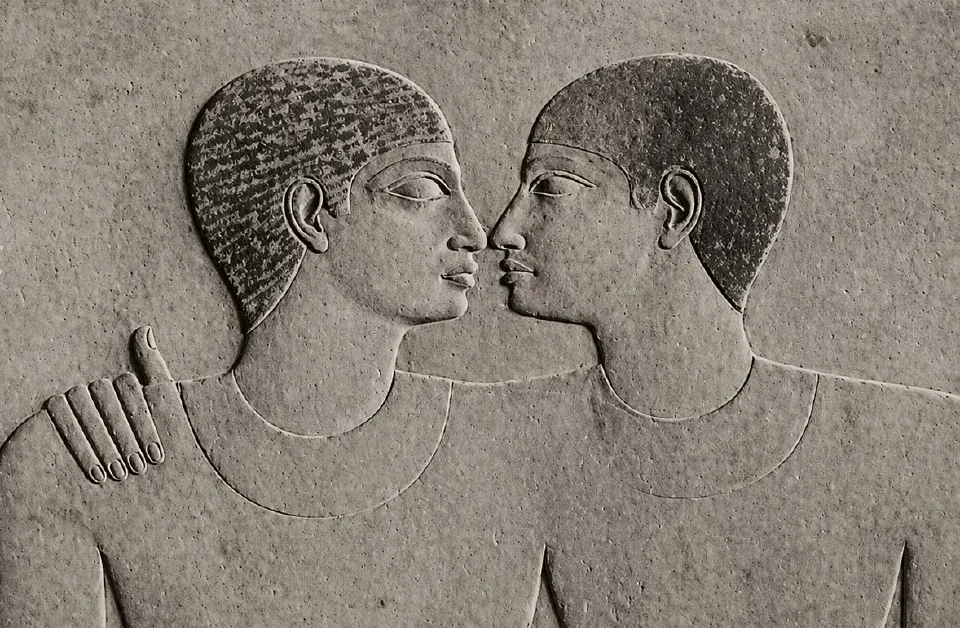
The plot of the confrontation between Horus and Set is found not only in papyri, but also in the wall paintings of Egyptian tombs. One of the most famous examples is associated with the tomb of Niankhkhnum and Khnumhotep. The two lived in Ancient Egypt and are considered to be the first known same-sex couple in history.
On one of the walls there is a depiction of Khnumhotep holding a lotus; There is a stage with musicians next to it. The leader of the choir addresses the three singers and two harpists with the words: “Play the one about the Two Divine Brothers.”
Researchers suggest that at a feast in honor of these men, a song related to the myth of the struggle between Horus and Set was performed. Such lyrics could be deliberately direct and even rude, so it is possible that such a song was perceived as an entertaining number at a festive feast for the nobility.
Literature and sources
Assmann J. Mort et au-delà dans l’Égypte ancienne, 2003.
Velde H. te. Seth, God of Confusion. 1967.
Parkinson R. B. Homosexual Desire and Middle Kingdom Literature. 1995.
Broze M. Mythe et roman en Égypte ancienne. Les aventures d’Horus et Seth dans le Papyrus Chester Beatty I, 1996.
Gerig B. L. Homosexuality and the Bible.
Reeder G. Same-Sex Desire, Conjugal Constructs, and the Tomb of Niankhkhnum and Khnumhotep, World Archaeology, 2000.
Parkinson R. B. Boasting about hardness: constructions of Middle Kingdom masculinity. // Sex and Gender in ancient Egypt. Edited by Carolyn Graves-Brown. 2008.