The Statue of Idet and Ruiu – Lesbians of Ancient Egypt?
Kinship or partnership – what the titles and the pose suggest.
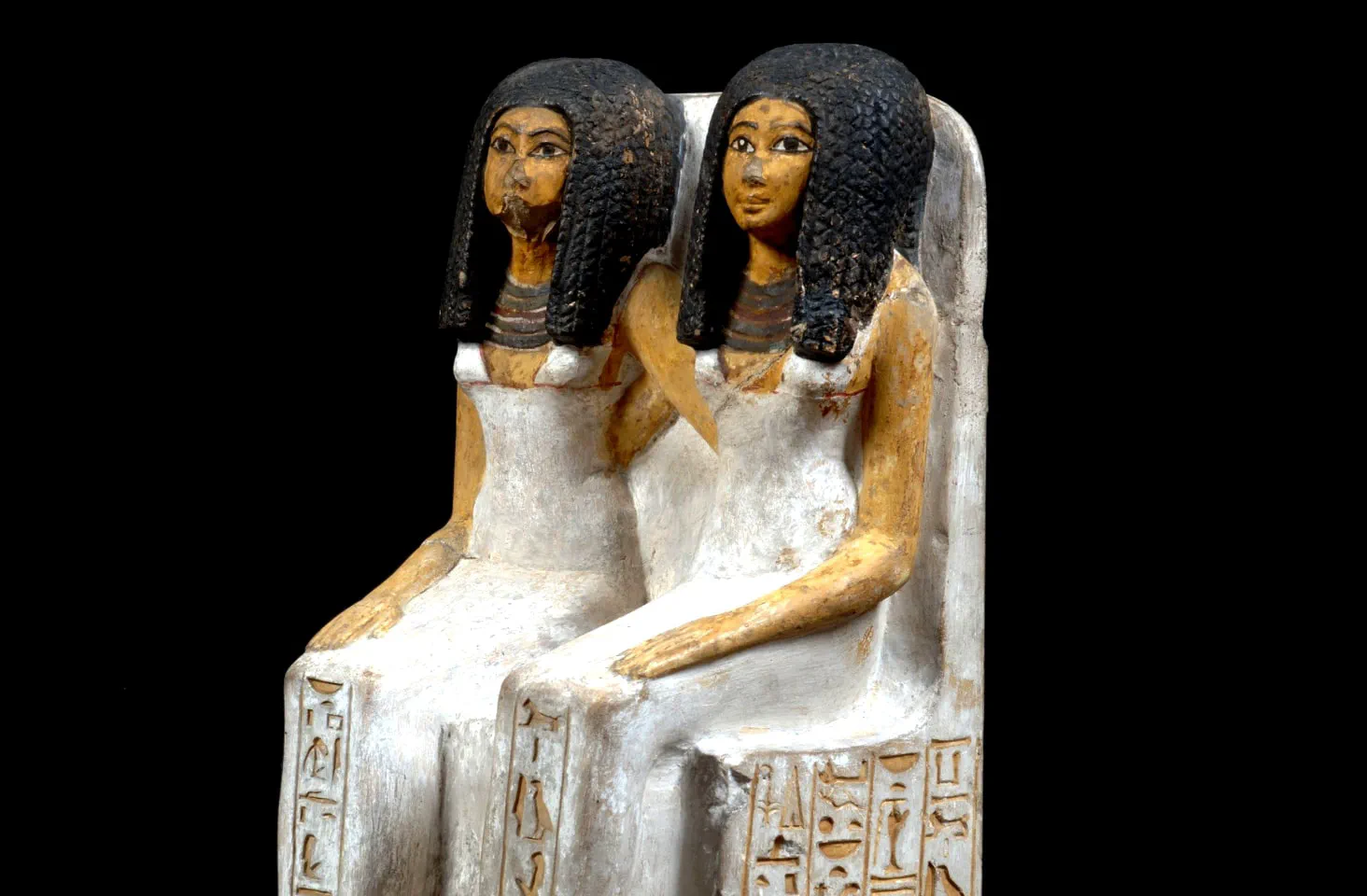
This sculpture dates back to the New Kingdom, during the 18th Dynasty (ca. 1480–1390 BC). This was the period of Egypt’s greatest power: the country expanded its borders, built large temples and created many works of art. Artists of that era preserved traditional forms, but already paid attention to the individual traits of people.
The work is thought to have been made at Thebes, in the area of Deir el-Medina. At the time, Thebes was among Egypt’s principal religious and political centers. Deir el-Medina was a village of artisans and painters responsible for building and decorating royal tombs.
The sculpture is carved from limestone, a soft stone widely used in Egypt for small-scale statuary. Originally the figures were brightly painted, since ancient Egyptian statues were almost always covered with polychrome decoration, most of which has typically been lost over time.
The sculptor’s name is unknown – an entirely normal situation for ancient Egyptian art, especially for smaller portrait statues of the 18th Dynasty.
The piece entered the museum in the 19th century and became part of the so-called “Old Collection,” assembled between 1824 and 1888. Precise information about who discovered the statue and under what circumstances has not survived.
Today the sculpture is housed in the Museo Egizio in Turin – one of the largest collections of ancient Egyptian art outside Egypt. In the museum catalogue it is registered under inventory number Cat. 3056.
The Bond Between Idet and Ruiu: Kinship or Romance?
The statue depicts two women sitting next to each other – Idet and Ruiu. The name Idet is sometimes rendered as Idu in English museum descriptions.
Idet sits on the right, on the side of honor (in Egyptian art the right side was considered more honorable). The inscription calls her “the lady of the house.” This title was usually borne by a married woman, the mistress of the house, and it indicated her high status. Ruiu does not have a title.
The women sit close to each other: one embraces the other, placing her hand behind her back. This pose is well known from the monuments of the 18th Dynasty, but spouses were usually depicted this way. At the same time, Idet appears to be the elder: she occupies a place of honor and bears a title. Ruiu is shown as a junior figure with no status.
On the back side of the statue are carved texts with offerings to the god Osiris, the ruler of the underworld. These are standard funerary formulas with wishes for good things for the soul of “the lady of the house Idet, justified” and for Ruiu. The word “justified” means that both women have already died and passed the judgement of Osiris. The statue was intended to commemorate them.
Museum descriptions indicate that the relationship between Idet and Ruiu is not spelled out in the texts. It is unclear whether they were mother and daughter, sisters, or spouses. No known Egyptologist directly calls them a romantic couple.
Such statues are rare, but not unique. Two other similar sculptures are known. One of them (from the Musée royal de Mariemont) preserves an inscription. There, the woman on the right is called “the lady of the house of Hetepet,” and the woman on the left is called “her daughter Mutui” (and she also has no titles). The combination of the same features and pose suggests that the Turin statue also depicts a mother and daughter.
But the very absence of a clear inscription deserves attention. In Egypt, kinship was usually indicated if it was important for status, inheritance, or commemoration. If the connection did not fit into the usual framework, they could simply pass it over in silence. Egyptian texts favored clear social roles: wife, daughter, sister.
Therefore, another interpretation cannot be completely ruled out. Perhaps we are looking at two women whose intimacy was romantic. The artist expressed it through a universal gesture of affection, which did not raise questions among his contemporaries.
The most cautious conclusion is that they are most likely mother and daughter. But the intimate pose and the silence of the inscriptions leave room for alternative interpretations. Perhaps it was a couple portrayed in such a way as to make the scene seem socially acceptable without further elaboration.
References and Sources
- Arnette, Marie-Lys. La gémellité biologique dans l’Egypte ancienne: synthèse des cas potentiels. 2017.
- Dief, Shaima. Ancient Egyptian Hybrid Deities in Visual Form as Mediator in Cultural Transmission. 2023.