Goddess Nephthys – A Lesbian?
What the sources say about the ancient Egyptian goddess of the night.
Contents
Who Is Nephthys
Nephthys was an ancient Egyptian goddess from the Heliopolitan Ennead, a group of nine major gods worshiped in Heliopolis.
Her name in Egyptian sounded like Nb.t-ḥw.t and literally meant “Lady of the House” / “Lady of the Temple,” that is, the mistress of the sacred space. This name immediately connects Nephthys with the cult, the temple, and the ritual.
Nephthys belongs to the main divine family of Egyptian mythology. She is the daughter of the sky goddess Nut and the earth god Geb, and the sister of Isis, Osiris, and Set. Therefore, she is included in the circle of central mythological subjects related to the structure of the world and ideas about posthumous fate.
Her role is especially noticeable in the myth of Osiris. In this myth, Set, personifying chaos and destruction, kills his brother Osiris and dismembers his body. After this, Nephthys acts together with Isis. Isis, the wife of Osiris and goddess of magic, mourns the dead; both sisters search for parts of his body, collect them, and help prepare Osiris for burial. The image of two sisters mourning and protecting a dead god together became an important part of Egyptian religion: it showed that death could be overcome through proper rites and ritual care.
From this grew the funerary role of Nephthys. She became one of the main goddesses associated with death. Nephthys looked after the dead, guarded mummies, and was symbolically present at funerals. It was believed that she protects the body of the deceased and helps them pass to the afterlife. Therefore, she was often painted on sarcophagi and in tombs next to Isis.
In the most ancient texts, Nephthys appears as the deity of the night. The Egyptians believed that the sun sailed on a boat through the sky and the underworld. Isis accompanies the solar barque during the day, and Nephthys at night. This emphasizes her connection with darkness and transition. She symbolizes the state “between,” when the soul has already left earthly life but has not yet been reborn in the afterlife.
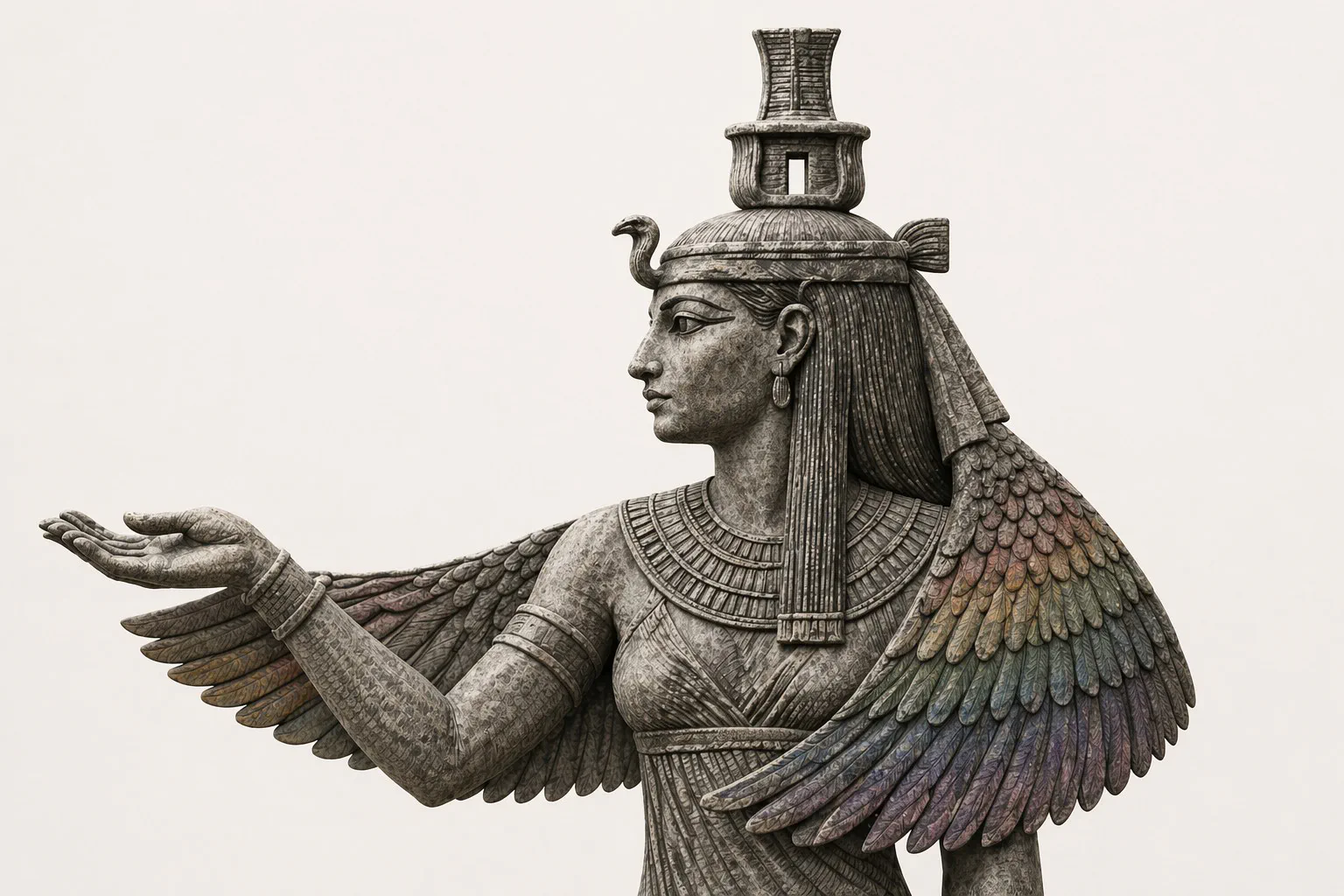
In art, Nephthys was often depicted with outstretched wings or in the form of a bird of prey, most often a vulture or falcon. Her wings cover the head and shoulders of the deceased and signify patronage and protection. The birds of prey themselves were associated with the sky and divine protection.
Her iconic attributes were easily recognizable. On Nephthys’ head were depicted the hieroglyphs “house” and “basket,” which together make up her name. In her hands she often held magical and royal symbols: the was-scepter, associated with power and order, the ankh – a sign of life, as well as other signs of protection and magic.
In later texts, the image of Nephthys expands. She is described as the goddess of help and support, caring and helpful; sometimes she is even called the “mother” of the pharaoh. At the same time, they also recognize her formidable side: it was believed that she could spew out flames and burn the enemies of the pharaoh, protecting his power and order in the country.
With all this, Nephthys usually remained secondary compared to Isis. She did not have an equally large independent cult, large individual temples, and widespread popularity. Most often, she was revered next to Isis and Osiris – as part of the general mythological circle, where she played an important, but auxiliary and more “shadowy” role. At the same time, researcher Racheli Shalomi-Hen points out that in writing, the names of most goddesses in Egypt were classified with the sign of a cobra or a falcon on a standard. However, Isis and Nephthys became the first deities whose names in the “Pyramid Texts” and “Coffin Texts” were denoted by the sign of an ordinary seated woman. According to the researcher, this suggests that in the religious thought of Egypt, Nephthys and Isis (as part of Osiris's earthly world) were perceived not as distant abstract deities, but as deeply anthropomorphic, “classless human beings”.
Why Nephthys Is Called a Lesbian
Some modern texts about the ancient Egyptian gods call Nephthys an “LGBT icon.” She has also been described as a “lesbian goddess” or, conversely, as a figure taken beyond sexuality.
Typically, such conclusions are based on a phrase from the Pyramid Texts. In one passage, Nephthys is called a “replacement without a vulva” (or a “fake woman without a vagina”).
When read literally, it sounds like a description of the body and a hint of sexuality. But in the text itself, the phrase functions differently. It lists deities that may appear in dangerous or irregular forms. To call them that means to neutralize, disempower, and stop them.
The second argument relates to the marriage of Nephthys and Set. Because of the phrase “without a vulva,” their union is often considered purely formal. In myths, this couple really does not have a common history, joint actions, and children. Marriage exists, but it does not look like a real family.
Separately, such interpretations use the myth of the birth of Anubis. In one of the variants, Nephthys conceives Anubis not from Set, but from Osiris: she takes the form of Isis and enters into a relationship with Osiris through substitution.
From this, popular media conclude: since Nephthys does not bear children for her husband, is considered “fake,” and is constantly next to her sister, then she is a lesbian. In blogs and esoteric projects, this label is used without reservations, without trying to understand ancient Egyptian culture.
From a scientific point of view, this needs to stop. There are no direct references in Egyptian texts to Nephthys having sexual relations with women. In Ancient Egypt, there was no concept of “sexual orientation” at all. Even the harsh phrase from the Pyramid Texts is part of a ritual, not a description of anatomy. Therefore, the statement “Nephthys was a lesbian” has no scientific support. These are just modern speculations.
At the same time, there is still interesting material here for queer scholars. Nephthys falls out of the usual roles: she does not become a typical wife and mother, and does not create a family. In rituals, she is described through substitution and “wrong arrival” – that is, through a violation of order.
That doesn’t make her a “lesbian.” But her image shows that Egyptian texts allowed for a female figure that was not limited to childbearing and domestic duties. Nephthys is an example of how myth can create femininity outside of conventional scripts.
Literature and sources
Mercer, The Pyramid Texts, 292; Pinch, 171
Shalomi-Hen R. The bearded woman and the queen. The formation and transformation of female divine classifiers. // Sex and Gender in ancient Egypt. Edited by Carolyn Graves-Brown. 2008.