A Queer Lexicon of Ancient Egypt
Exploring Ancient Egyptian terms for same-sex practices.
Contents
How to Read Ancient Egyptian Language
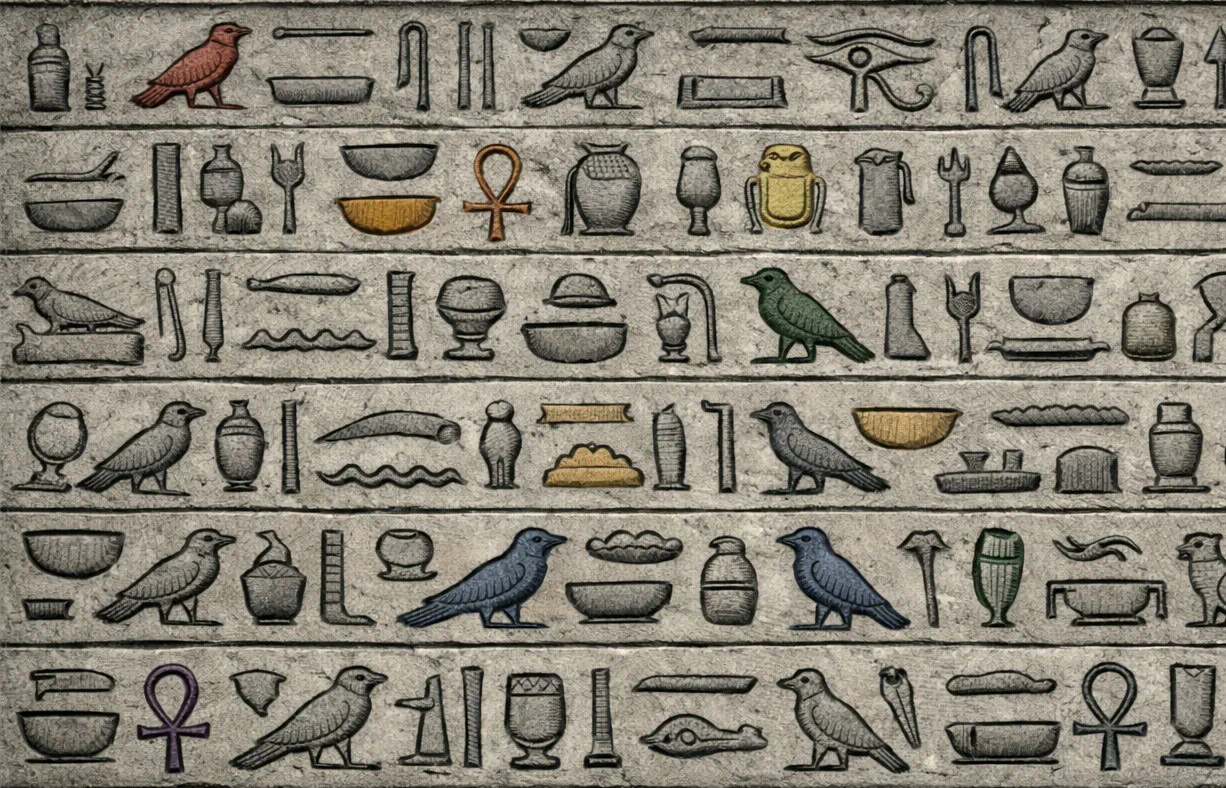
We don’t know what the ancient Egyptian language actually sounded like. The main reason is that the writing system almost did not convey vowels.
The Egyptians wrote in hieroglyphs, and later used faster systems – hieratic and demotic. In all cases, the script recorded mainly consonants. What vowels stood between them, whether they were long and where the stress fell, were usually not noted in writing. Therefore, only the “skeleton” of words has reached us.
For example, the entry kȝ nḫt twt mswt, one of Tutankhamun’s names, does not contain vowels. Therefore, it is impossible to say with certainty which sounds between the consonants were pronounced in the place of “a”, “e” or “u”. In Russian this can be represented like this: if you write down only consonants, the combination “kt” (кт) can be read as “kot” (cat), “kit” (whale), “kota” (of a cat) and many other ways. Without context, such reading is almost impossible.
Sometimes the pronunciation can be clarified using Egyptian words in texts in other languages. Such cases are useful, but rare. In addition, a foreign language usually distorts the original sound, adjusting the word to its own rules. Therefore, we are not talking about an exact transmission of sounds, but only about an approximate reconstruction.
So that ancient Egyptian texts could be read aloud, Egyptologists developed a conventional pronunciation – Egyptological. They insert vowels into consonant entries, most often e or a. Therefore, nfr is usually read as “nefer,” although it is not certain that the word sounded exactly like that.
This also explains the discrepancy in the transmission of names in different traditions. In the Russian language, the spelling “Тутанхамон” (Tutankhamon) has become established, while in English-language literature “Tutankhamun” is more often found.
Gay Dictionary of Ancient Egypt
nk [nek] – perform a penetrative sexual act
It is a basic and neutral verb for sex. The word itself does not call an action a “sin” or a “perversion.” In funerary texts, sex and semen are often symbols of life force and rebirth after death.
A number of formulas clearly refer to the heterosexual context. But there are also options that talk about “doing nk in the anus.”
nkk(w) [nekk(u)] – a man in the receiving role during anal penetration
The word nkk(w) literally means “one to whom nk is done.” It describes a man with whom a penetrative sexual act is performed.
In the 125th chapter of the Book of the Dead, in the so-called negative confession, there is the phrase: “I am not nk in nkk(w).” This means: “I did not penetrate a passive man.” The deceased declares to the gods that he did not do this.
Because of this formula, some researchers translate nkk(w) as “gay.” This is unlikely to be an exact match.
nkw [neku] – a man in an active role in penetrative sexual intercourse; also: fornicator
The word is formed from the root nk. By meaning, nkw is an active partner, “the one who performs” the penetrative act.
In sources, this word is sometimes used as a curse word – to denote a person who is considered dissolute.
ḥnn [henen] – phallus; penis
The word ḥnn means “phallus” or “penis” and is found in religious and medical texts. This is a basic anatomical term.
The Pyramid Texts (Pyramid of Unas, PT 317) say:
“Unas eats with his mouth, Unas urinates with his phallus and copulates.”
Here ḥnn is not just a part of the body, but a sign of the vitality and creative power of the deceased king, who retains bodily and sexual functions in the afterlife.
In medical papyri, for example, in the papyrus of Edwin Smith (X,13), the word is used in the literal sense:
“His penis became hard as a result (that is, became erect).”
Here ḥnn denotes the physiological state of the organ and is used without mythological or symbolic connotations.
ẖr.wj [herui] – testicles; testes
It is a masculine noun in the dual form, literally meaning “two”. The root is associated with the word ẖr – “under”, “from below”, so the expression can be understood as “those two from below”.
In the Pyramid Texts (version from the Pyramid of Pepi I, PT 359) the formula is found:
“Horus cried out/moaned because of his eye, and Set because of his testicles.”
This line refers to the mythological conflict between Horus and Set: Horus’s eye is damaged, Seth’s genitals are damaged.
mtw.t [metut] – seed (sperm)
The word mtw.t literally translates as “seed, sperm.” Sometimes it was used in a figurative sense – “son” or “begetting”.
This word is also found in funeral texts, where bodily fluids and functions are described as signs of the strength and preserved vitality of the deceased.
For example, the Pyramid Texts (Pyramid of Pepi I, PT 493) say:
“The air is in my nostril, the seed is in my penis, like the “Mysterious Form” that is in the midst of the radiance of light.”
ꜥr.t [aret] – butt
The word means the back part of the body – “hind parts”, “buttocks”, less often “anus”.
In the Pyramid Texts, in the tradition of the confrontation between Horus and Set, the following formulation is found:
“Horus put his seed in Seth’s ass;
Set put his seed in Horus’s ass."
We have a separate article about this episode:
pḥ.wyt [pehuit] – anus
The word means “anus”; it can also be used to mean “rectum.” It often looks more medical in tone, although it is found not only in medical texts themselves.
For example, it is mentioned in the Hearst papyrus. There are formulas like: “Medicine for the anus when it hurts” and “Medicine for cooling the anus.”
ḫpd [heped] – buttocks
Another word with the meaning “buttocks”, “backside”, “back of the body”.
It is found in literary texts of the Middle Kingdom. In the same “History of Horus and Set,” the word ḫpd is used in a specific bodily context: “If he applied force to you, then you must press your fingers between your buttocks.” Here it denotes an anatomical part of the body without euphemisms or figurative meanings.
ḥm.tj [hemti] – abusive designation for an effeminate person or a coward
This offensive word literally means “one who turns his back.” It is not directly related to the word hmt (“woman”). But the Egyptians, apparently, understood the play on words: the enemy was described both as a “woman” and as one who cowardly shows his back. This made the insult stronger.
The term is attested in magical texts, in particular in the Magic Papyri corpus. One of the lines literally reads like this: “You unlawfully desecrated the effeminate on the fiery hill of Hetepet.”
ḥm.t-ẖrd [hemet-khered] – “woman-boy”
This is the name of a young man who is described as effeminate and as a person occupying a “feminine” socio-gender role in sex.
The expression is found in the 32nd maxim of Ptahhotep, part of his teachings – an ancient Egyptian text of an instructive nature.
In this maxim the teacher warns: “Do not have nk (coitus) with hmt-hrd, for you know that what is resisted will become water on his chest… Let him cool down, destroying his desire.”
Here hmt-hrd is understood as a young man in a “feminine” role, and his desire is described as obsessive and unrelieved.
About Sexuality in Ancient Egypt
The ancient Egyptian language did not have a word that exactly corresponds to the modern concept of “homosexual.” Apparently, there was no idea of sexuality as a stable and basic characteristic of personality.
Therefore, attempts to “find homosexuality” in Ancient Egypt often look like an anachronism. We transfer modern concepts into the past and attribute to ancient texts something that is not there. The Egyptians described themselves differently, not within the framework to which we are accustomed. At the same time, same-sex attraction itself, of course, existed.
It is more useful to study Egyptian terms and how the Egyptians themselves described their experiences and norms. But few texts about the sexual sphere have survived.
Firstly, the topic was considered obscene. Much was said through hints and jokes, avoiding direct words. Secondly, few people knew how to write. The surviving texts reflect the official view: what the educated elite considered necessary and acceptable to write down.
Still, words for same-sex practices existed. They usually described the penetrating action and its evaluation. Such words are often associated with power, control and humiliation, rather than with love and personal feelings.
Literature and sources
- Richard Parkinson. Homosexual Desire and Middle Kingdom Literature. (The Journal of Egyptian Archaeology). 1995.