Muzhik-Maslenitsa: A Maslenitsa Figure of a Man Dressed as a Woman
A cross-dressed Maslenitsa figure described in early twentieth-century Russian folklore materials.
- Editorial team
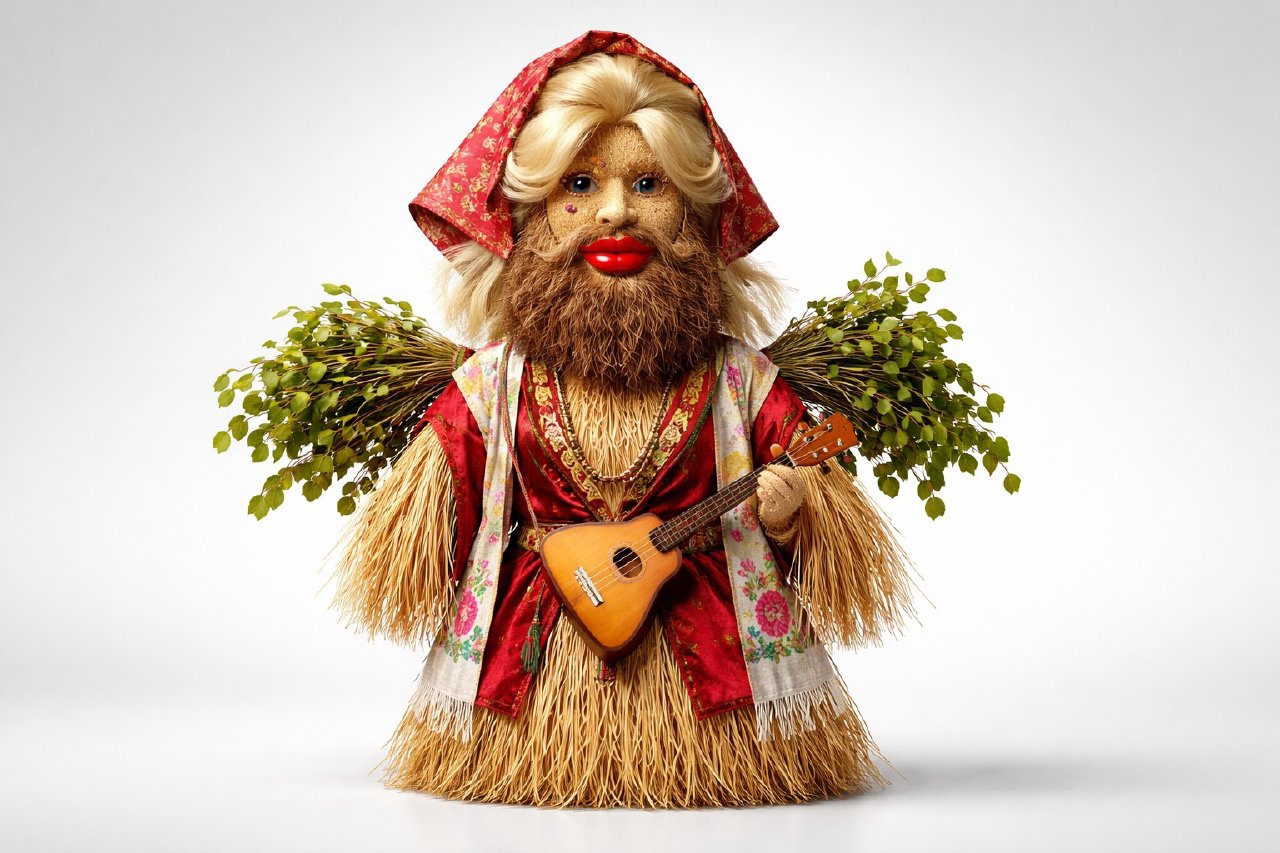
Maslenitsa is the Russian name for Cheesefare Week, the last week before Great Lent in the Orthodox calendar. Its date changes every year because it is tied to Pascha, or Easter. During this week meat has already been excluded from the diet, while butter, dairy products, and eggs are still permitted. Blini gradually became the best-known festive food of the season and one of the most recognizable symbols of Maslenitsa.
Descriptions of Maslenitsa usually bring together two layers of meaning. One belongs to the Orthodox liturgical calendar and the preparation for Lent. The other preserves older folk customs: sleigh rides, noisy street processions, games, masking, and festive role reversal.
Today the straw effigy is one of the most familiar images associated with Maslenitsa. Historical ethnographic descriptions, however, show that such an effigy was not universal in every region. Where it did appear, it often stood at the center of the celebration.
The effigy was usually made on a large scale. Its frame could be a cross-shaped construction of two sticks wrapped in straw or simply a large straw bundle. The upper part was formed as a head, the lower as a body. To make the figure more visible, people often fixed it to a long pole.
Its clothing varied from place to place. In some areas the effigy wore a caftan and a hat, was belted with a sash, and was given bast shoes. In others it was dressed in women’s clothing, such as a blouse, sarafan, or skirt, with a kerchief tied around the head. The figure could then be placed in a sleigh and taken in procession with songs to a hill, where the ceremonial “welcoming of Maslenitsa” took place according to local custom.
Muzhik-Maslenitsa
A striking early twentieth-century description of Maslenitsa appears in Apollon Apollonovich Korinfsky’s 1901 book Narodnaia Rusʹ: Kruglyi god skazanii, poverii, obychaev i poslovits russkogo naroda (“Folk Russia: The Full Year of Tales, Beliefs, Customs, and Proverbs of the Russian People”). In a chapter on Maslenitsa, Korinfsky describes a festive figure that had, as he puts it, turned “into a man dressed as a woman.”
In English, this figure is described most naturally as a cross-dressed carnival or mumming character: a male performer costumed in women’s dress for comic and ritual effect. The humor comes from deliberate gender incongruity staged in a festive public setting.
Korinfsky writes:
Honest folk ate their fill of blini. Then, with songs and dancing, they carried and drove through the streets a tree fancifully decorated with little bells, larger bells, and bright scraps of cloth. After that they drove around “Maslenitsa,” who had, for some reason, turned from a beautiful goddess into a man dressed as a woman, hung with birch veniki and holding a balalaika in his hand. A whole train was assembled. In front raced painted sleighs, and in some places even a boat mounted on runners, harnessed “goose-fashion” to ten to twenty horses, with a rider on each horse carrying a broom. Besides the balalaika, Muzhik-Maslenitsa from time to time held a shtof of “the sovereign’s wine,” and now and then also drank from a small barrel of beer standing beside the tubs and the box for blini.
Several details in this description matter. A shtof was an old bottle or decanter used as a standard measure, and “the sovereign’s wine” was an old Russian expression for vodka. The venik mentioned here is the familiar bundle of birch branches associated with the bathhouse. Together the balalaika, the birch veniki, the vodka, the beer, and the blini create a deliberately excessive festive image built from recognizable markers of popular celebration.
Korinfsky also describes the larger procession. Behind the first sleigh came others filled with dressed-up young men, girls, and children. Bells rattled, balalaikas sounded, songs were sung, and local residents came out of their houses to join the moving crowd. The leading sleigh was called the “ship” and could be decorated with brooms and towels to resemble masts and sails. This ceremony belonged to the opening of Maslenitsa week, traditionally associated with its “meeting” or formal welcoming.
The figure of Muzhik-Maslenitsa reveals a familiar principle of folk festive culture: the temporary inversion of ordinary roles. During Maslenitsa, the world could be shown in a deliberately altered form. A holiday figure named Maslenitsa might appear as a man in women’s dress, carrying musical instruments, bathhouse birch bundles, and alcohol through the street in a noisy procession.
Seen in that light, Muzhik-Maslenitsa is best understood as a mask of festive reversal. The point of the costume lies in the visible mismatch itself. It marks the holiday as a time when everyday categories could be loosened, mocked, and theatrically rearranged in public.
References and Sources
- Коринфский, А. А. Народная Русь: Круглый год сказаний, поверий, обычаев и пословиц русского народа. 1901. [Korinfsky, A. A. - Folk Russia: A Year-Round Cycle of Legends, Beliefs, Customs, and Proverbs of the Russian People.]
🇷🇺 LGBT History of Russia
General history
- Homosexuality in Ancient and Medieval Russia
- The medieval Arabic source that called the women of the Rus the world's first lesbians
- The Homosexuality of Russian Tsars Vasily III and Ivan IV the Terrible”
- Peter the Great’s Sexuality: Wives, Mistresses, Men, and His Connection to Menshikov
- Homosexuality in the 18th-Century Russian Empire — Europe-Imported Homophobic Laws and How They Were Enforced
- Russian Empress Anna Leopoldovna and the Maid of Honour Juliana: Possibly the First Documented Lesbian Relationship in Russian History
Folklore
Biographies
- Grigory Teplov and the Sodomy Case in 18th-Century Russia
- Russian Poet Ivan Dmitriev, Boy Favourites, and Same-Sex Desire in the Fables 'The Two Doves' and 'The Two Friends'
- The Diary of the Moscow Bisexual Merchant Pyotr Medvedev in the 1860s
- Sergei Romanov: A Homosexual Member of the Imperial Family
- The Possible Homosexuality of Grand Duke Nikolai Mikhailovich of the Romanov Family
- Andrey Avinoff: A Russian Émigré Artist, Gay Man, and Scientist
 Subscribe to our Telegram channel (in Russian): Urania. With Telegram Premium, you can translate posts in-app. Without it, many posts link to our website, where you can switch languages — most new articles are published in multiple languages from the start.