The Cross-Dressing Bogatyr: A Russian Bylina About Mikhailo Potyk, Who Disguises Himself as a Woman
Why does the hero put on “women’s clothing”?
Contents
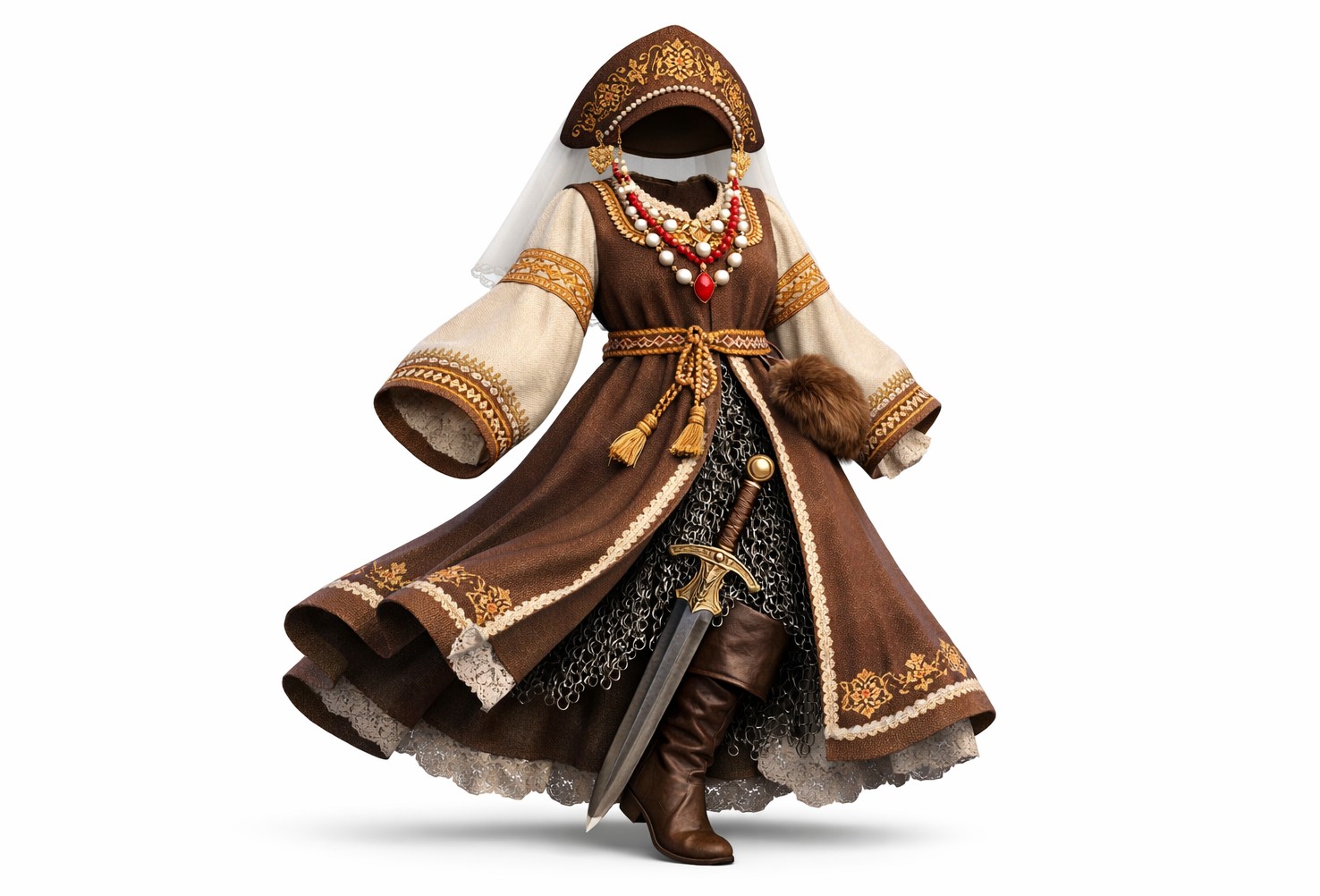
Russian byliny (epic songs) contain a rare plot about the bogatyr (epic warrior) Mikhailo Potyk, who twice disguises himself in women’s clothing. Why does he do this? And how does this motif work inside the epic? This article briefly retells the bylina’s plot, then focuses in detail on the two episodes in which cross-dressing appears: once as a way to defeat enemies, once as a way to save the hero’s life.
Who is Mikhailo Potyk?
Mikhailo Potyk is a young Russian bogatyr. In the byliny he is described as a handsome, strong, and courageous warrior with golden curls. He fights evil beings — serpents and monsters — that embody the forces of darkness.
Potyk belongs to Prince Vladimir’s circle of Kievan bogatyrs and acts alongside Ilya Muromets and Dobrynya Nikitich. At the same time, the bylina assigns them different age roles: Ilya is called old, Dobrynya young, and Potyk affectionately “dear one.”
According to one interpretation, the hero’s name is related to potka, an old word meaning “bird.” This creates a link to ancient ideas about birds as mediators between worlds.
The bylina about Mikhailo Potyk was especially widespread along the northern and eastern shores of Lake Onega. On the Pudoga River it was recorded from seven storytellers. These texts are notable for their complex composition and for the way they preserve fine plot details.
The plot of Potyk belongs to the most complex and multilayered group in the Russian epic tradition. Scholars often see at its core an ancient myth about the marriage between a human being and a creature from another world. The hero’s beloved, Marya the White Swan, combines the features of a bird and a serpent.
Retelling the bylina
Prince Vladimir holds a feast and gives three bogatyrs their assignments. Ilya Muromets is to ride to the Sorochinsk Hills and fight the enemy. Dobrynya Nikitich is to cross the Blue Sea and annex new lands. Mikhailo Potyk is ordered to collect tribute from Tsar Likhodei of Podolia.
On the road, Potyk pitches a white tent with a golden top in the open field. It is noticed by Tsar Likhodei’s daughter, Marya Podolenka, who comes to the bogatyr by night. Potyk’s horse speaks in a human voice and wakes its master. Mikhailo sees the girl, falls in love with her, and hears her ask him to take her to Kiev, baptize her, and marry her. He agrees.
In Kiev she is baptized and receives the name Nastasia the White Swan. After the wedding the couple makes a vow: if one dies, the other will lie beside them in the grave.
Later Vladimir gathers another feast. The bogatyrs boast of their deeds. Potyk says that he has collected tribute from Tsar Likhodei and married his daughter. After this, the prince sends him to collect tribute from Tsar Nalyot, who lives beyond the Blue Sea.
When Potyk arrives there, a dove flies into the tsar’s hall and brings news of Nastasia’s death. Mikhailo immediately returns to Kiev, confirms that his wife is dead, and orders a double oak coffin to be made. Fulfilling his vow, he lies down beside her body.
For three months Potyk lies in the coffin underground. Then a serpent crawls in to drink Nastasia’s blood. Mikhailo seizes it with iron tongs and forces it to bring him the water of life. As a pledge, he takes one of the serpent’s young and kills it. Terrified, the serpent brings the water. Potyk first revives the serpent’s young, then revives his wife. The husband and wife emerge from the grave.
News of the miraculous resurrection and of Nastasia’s beauty spreads quickly. Forty tsars and kings want to marry her. They send envoys to Kiev and demand that Prince Vladimir surrender Nastasia, threatening to destroy the city if he refuses.
Vladimir asks Potyk to yield for the sake of Rus’, though he refuses and puts on women’s clothing:
He arrayed himself in women’s dress,
Set chain mail and armor on his good horse,
Took up his tempered sword and sharp saber,
And went out to the Sorochinsk Hills.
He left his horse beneath an oak,
And took with him his strong bow.
Then he came to the green meadows,
To the silken grasses.
Disguised, the hero enters the enemies’ camp and proposes a contest. He shoots an arrow and promises to marry the one who finds it. While the tsars rush off in search of the arrow, Potyk seizes their weapons and kills them.
Then fortune turns back into disaster. Tsar Vakhramei abducts Nastasia and carries her off to the land of Volyn. Potyk rushes after them, though Nastasia now loves Vakhramei and deceives her husband. She gives him “forgetful” wine. Mikhailo falls into a deep sleep and is turned to stone.
Three years pass. Ilya Muromets and Dobrynya Nikitich go in search of their missing companion. On the way they meet an old man who shows them the enchanted stone. The bogatyrs cannot move it, though the old man lifts it himself, and Potyk comes back to life. Then the old man disappears. The heroes understand that Saint Nicholas has helped them.
When Potyk comes to himself, he learns that Nastasia is living with Vakhramei and rides again to Volyn. There she deceives him once more: she again gives him forgetful wine, then orders that her husband be nailed to the wall.
Mikhailo is saved by Vakhramei’s daughter Marya. She takes pity on him, heals him, and helps him escape. To get out of the city, Potyk once again dresses as a woman:
They took a horse from the deep cellar,
They took the armor from the palace,
Dear Mikhailo Potyk Ivanovich
Dressed himself in women’s clothing,
Put the armor on his good horse,
Took the horse by the bridle,
And led it beyond the city wall.
Beyond the wall he clothed himself again and put on his mail.
Outside the city wall he puts his armor back on, marches against Vakhramei, and takes the city. In battle Potyk kills the tsar, then executes Nastasia: he orders her tied to seven horses and torn apart. Afterward he marries Marya Vakhrameevna and becomes ruler of that land.
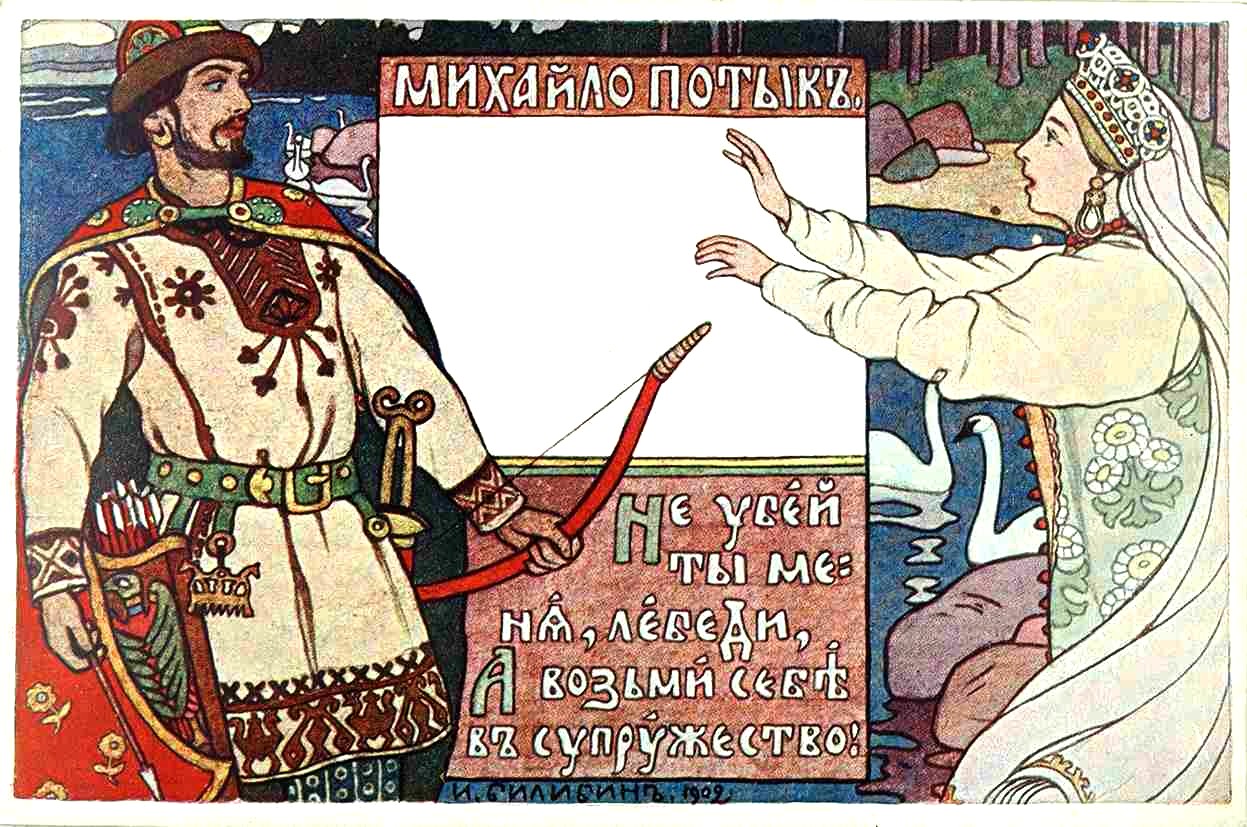
How the cross-dressing motif works
In the second episode, the function of the disguise is clear. The hero uses women’s clothing as camouflage so that he can leave the city unnoticed, pass beyond the wall, arm himself again, and return to open action.
In the first episode, the motif is more complex. Potyk changes clothes before slaughtering the forty tsars and kings, although by the logic of the bylina world he has no practical need for such a trick: his strength is enough for direct combat. For that reason, this scene looks less like a purely tactical move and more like a special narrative device whose meaning inside the bylina extends beyond military cunning.
The mythological layer of the plot
Scholars connect the bylina of Potyk with very ancient beliefs, including funerary rites and the motif of “winning a bride” from the other world.
The central image here is Marya the White Swan. She combines the features of a bird and a serpent. For that reason she has been compared with snake-legged goddesses known from Iranian and Scythian-Sarmatian myths. Herodotus wrote about such figures: in his account, the Scythians traced their origin to the son of Heracles and a serpent-goddess who lured the hero into her cave.
The scheme in the bylina is similar. Marya herself initiates the marriage with Potyk and calls him to lie with her in the earth. The hero’s descent into the grave is interpreted here as a trial rather than a simple death. Potyk takes food and weapons with him because he knows danger awaits. In the underworld he defeats the serpent, obtains the water of life, revives Marya, and returns.
How scholars interpret the bylina
One folkloristic interpretation sees this plot as a reflection of a struggle between an old matriarchal world and a new masculine, heroic principle. In this reading, Potyk embodies a Slavic world emerging from the influence of nomadic Scythian-Sarmatian traditions and forming its own culture. The union between Potyk and Marya then becomes a clash between two worlds — Slavic and steppe — and the hero’s victory marks the birth of a new type of person: a warrior and protector rather than a captive of magical power.
At the same time, Potyk’s character is internally contradictory. In the first part of the bylina he is far-seeing, decisive, and self-reliant. He ignores the advice of Vladimir and the Kievan bogatyrs, goes into the grave with his dead wife of his own will, foresees the encounter with the serpent, and knows how to obtain the water of life. In the second part this same hero becomes trusting and careless. He falls into traps and survives only because others help him.
Boris Putilov explained this through the contrast between the hero’s “sight” and “blindness.” Such a contrast is typical of the Russian epic tradition. Another explanation is also possible: the bylina took shape gradually, and its parts may long have existed as separate songs — one about the underworld, another about the hero’s return.
From the point of view of the axiological approach in folklore studies, this plot can be read as a story of passion that blinds the hero, leads him into wrongdoing, then into punishment, and finally into repentance. In that interpretation, Potyk’s path becomes a path of spiritual purification.
Researchers have also long noted the fairy-tale character of the byliny about Potyk. They pointed to numerous parallels with folktales from almost every European country. On the whole, this cycle stands closer to the Western European fairy-tale tradition than to the Asian one. At the same time, it also contains a few separate parallels with episodes from the Mongolian epic of Geser Khan.
References and Sources
- Миронов А. С. Аксиологический анализ былин о Дунае и Потыке. Проблемы исторической поэтики, 2020. [Mironov A. S. – Axiological Analysis of Bylinas about Dunay and Potyk]
- Свод русского фольклора. Былины. Т. 17: Былины Пудоги. 2014. [Collective authorship – Corpus of Russian Folklore. Bylinas. Vol. 17: Bylinas of Pudoga]
🇷🇺 LGBT History of Russia
General history
- Homosexuality in Ancient and Medieval Russia
- The Story of a Medieval Arabic Source in Which the Women of the 'Rus' Were Called the World's First Lesbians
- The Homosexuality of Russian Tsars Vasily III and Ivan IV the Terrible
- Peter the Great’s Sexuality: Wives, Mistresses, Men, and His Relationship with Menshikov
- Homosexuality in the 18th-Century Russian Empire — Homophobic Laws Borrowed From Europe and How They Were Enforced
- Russian Empress Anna Leopoldovna and the Maid of Honour Juliana: Possibly the First Documented Lesbian Relationship in Russian History
Folklore
Biographies
- Saint Moses the Hungarian – One of the First Queer Figures in Russian History?
- Grigory Teplov and the Sodomy Case in 18th-Century Russia
- Russian Poet Ivan Dmitriev, Young Favourites, and Same-Sex Desire in the Fables 'The Two Doves' and 'The Two Friends'
- The Diary of Pyotr Medvedev, a Bisexual Moscow Merchant, 1854–1863
- Sergei Romanov: A Homosexual Member of the Imperial Family
- The Possible Homosexuality of Grand Duke Nikolai Mikhailovich of the Romanov Family
- Andrey Avinoff: A Russian Émigré Artist, Gay Man, and Scientist
 Subscribe to our Telegram channel (in Russian): Urania. With Telegram Premium, you can translate posts in-app. Without it, many posts link to our website, where you can switch languages — most new articles are published in multiple languages from the start.