Aleksey Apukhtin: Homosexual, Poet, and Friend of Tchaikovsky
Also the author of popular romances and poems that do not indicate the addressee's gender.
Contents
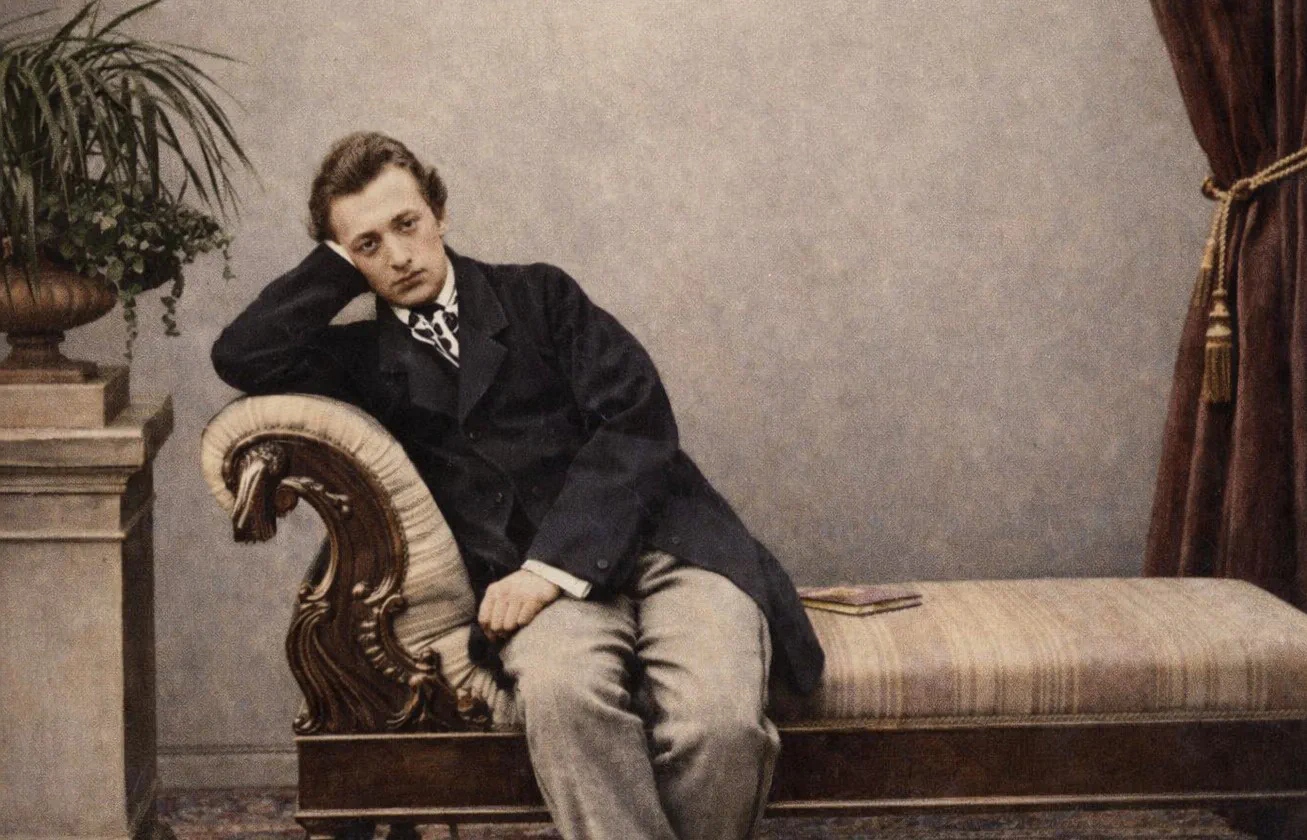
Aleksey Nikolayevich Apukhtin is known primarily as the author of poems that became popular romances: “Frenzied Nights, Sleepless Nights” (Russian: Nochi bezumnye, nochi bessonnye), “A Pair of Bay Horses” (Para gnedykh), “Does the Day Reign?” (Den li tsarit). Set to music, these texts eventually overshadowed the rest of the poet’s work.
Meanwhile, in the culture of Russia, Apukhtin became a crucial connecting link between the romanticism of the Golden Age and the psychologism of the Silver Age. In the history of literature, he remained not only as a prominent lyric poet of the Alexander III era but also as a man whose biography is inextricably linked with the life of the composer Pyotr Tchaikovsky.
Documentary sources, letters, and memoirs confirm their deep affection and same-sex attraction. Researchers also find a reflection of this identity in Apukhtin’s texts, noting a “poetics of evasion” in his love lyrics — a virtuoso and consistent avoidance of indicating the addressee’s gender.
Childhood and the School of Jurisprudence
Aleksey Apukhtin was born on November 15 (27), 1840, into a modest noble family in the city of Bolkhov, Oryol Governorate, and his childhood was spent on his father’s family estate in the village of Pavlodar. His mother, Maria Andreyevna (née Zhelyabuzhskaya), instilled in her son a passionate love for poetry. The impressionable boy possessed a phenomenal memory and easily learned huge texts by heart.
Those around him recognized Apukhtin’s outstanding literary talent early on. In May 1853, he entered the Imperial School of Jurisprudence in St. Petersburg. Just a year later, during the Crimean War, the fourteen-year-old student made a loud debut in print with the patriotic poem “Epaminondas” (Epaminond), which was followed by success in the authoritative journal Sovremennik (The Contemporary). Writers Ivan Turgenev and Afanasy Fet prophesied a brilliant future for the young man, and critic Aleksandr Druzhinin, having met him in December 1855, recorded:
“[Leo] Tolstoy introduced me to the boy-poet Apukhtin, from the School of Jurisprudence.”
— Aleksandr Druzhinin. “Diary” (1855)
The School of Jurisprudence itself, opened in 1835 to train the highest bureaucratic elite, was famous not only for its excellent education: it was one of the main centers of homosocial culture in St. Petersburg. In the closed all-male institutions of that time, emotional and sexual connections easily developed between students.
This tradition was recorded even by subcultural literature: for example, the collection Russian Eros Not for Ladies (Russkiy erot ne dlya dam), published anonymously in Geneva in 1879 in a tiny print run. It used the intimate folklore of elite schools as a political weapon to discredit high-ranking graduates (including Minister of Justice Dmitry Nabokov and Ober-Procurator of the Most Holy Synod Konstantin Pobedonostsev), and its preface openly pointed to the wide prevalence of homosexual relationships.
It was in this specific environment that the paths of Aleksey Apukhtin and Pyotr Tchaikovsky crossed, finding themselves in the same class. Apukhtin, possessing a brilliant intellect and the stellar status of a literary child prodigy, quickly took a dominant position and became a mentor for his less confident classmate. He helped his friend make sense of his first infatuations — for example, his strong feelings for a younger fellow student, Sergey Kireyev. Writer Nina Berberova described the influence of the thirteen-year-old Apukhtin, whom she explicitly called a “seducer”:
“Everything that had hitherto been sacred to Tchaikovsky, the concept of God, boyish love for his neighbor, respect for his elders — all this was suddenly showered with mockery… Tchaikovsky felt that his whole self, with all his thoughts and feelings, was changing before his eyes… Next to him, Tchaikovsky seemed a boy of average abilities, endearing himself to people with some kind of harmlessness, colorlessness…
At night in the dormitory [shared sleeping quarters] they whispered until midnight (their beds stood side by side); they had secrets buried from others for life. They loved each other, one — with a shade of patronage and power, the other with envious anxiety: for Apukhtin everything was clear, he was already a formed man, with talent, with future glory. For Tchaikovsky — everything was dark.”
— Nina Berberova. “Tchaikovsky” (1936)
The influence of Apukhtin and the atmosphere of the closed institution helped the composer understand himself. According to Berberova’s testimony, after several attempts to become interested in young women from high society, the young Tchaikovsky finally accepted his nature:
“Just a year later, he felt a complete, final, insurmountable indifference to women.”
— Nina Berberova. “Tchaikovsky” (1936)
In the summer of 1857, Apukhtin wrote a humorous poem to his friend with a reference to a St. Petersburg pastry shop familiar to them both. In it, an innocent joke about sweets naturally turns into a joke about a kiss:
But as for his friends, in defiance of fate,
He remembers them forever and yearns,
Over macarons, he dreams of you,
And over "meringue," he kisses you...
(In the 19th-century pastry context, “macarons” referred to sweet almond cookies, now known as macarons. — Ed. note)
In 1859, Apukhtin graduated from the school with a gold medal, but the triumph was marred by his mother’s death. This loss became a crushing blow for him and laid the foundation for his deeply elegiac style, permeated with the motif of existential loneliness.
Service, Criticism, and the “Shotan” Scandal
After graduation, the friends continued to stick together: Apukhtin and Tchaikovsky served in the Ministry of Justice and, according to rumors, lived in the same apartment. Publisher Aleksey Suvorin recorded in his diary for 1889 the words of his acquaintance Maslov about this period:
“Tchaikovsky and Apukhtin are both pederasts; they lived like husband and wife… Apukhtin played cards. Tchaikovsky would come up and say he was going to sleep. Apukhtin would kiss his hand and say: ‘Go, my dove, I will come to you in a moment.’”
— Aleksey Suvorin. “Diary”
However, their carefree youth soon collided with harsh realities. At the turn of the 1850s and 1860s, Russian society was experiencing radical changes. Literature began to be dominated by democratic critics who demanded civic service and social utility from poetry. In 1859–60, critic Nikolay Dobrolyubov published caustic reviews and parodies under the pseudonym Konrad Lilien-Schwager, accusing Apukhtin’s poems of “boudoir-style” and detachment from the suffering of the people. Dobrolyubov derived a rigid formula of class antagonism:
“The public sleeps, the people have long since risen and are working. The public works (mostly with their feet on the parquet), the people sleep or are already getting up again to work… in the public there is dirt in gold, in the people — gold in dirt.”
— Nikolay Dobrolyubov
This deeply wounded the sensitive poet. Unwilling to adjust his talent to political expediency, he made a cardinal decision: he stopped publishing in the press for more than twenty years.
A social blow soon followed. In 1862, Tchaikovsky, Apukhtin, and several of their former classmates found themselves at the center of a scandal surrounding the St. Petersburg restaurant “Shotan.” According to the memoirs of the composer’s brother, playwright Modest Tchaikovsky, the participants of the feast were “defamed throughout the city as bugry.”
The word bugr or bugor in 19th-century Russian urban slang referred to a homosexual man. It derives from the French bougre, which traces back to the Late Latin ethnonym bulgarus (Bulgarian). In the 11th–13th centuries, the French Catholic Church used it to call the Cathar and Bogomil heretics (whose teachings came from the Balkans), accusing them of rejecting reproductive sex and engaging in sodomy. Over time, the word penetrated Russia through the Francophone aristocracy.
In the Russian Empire, homosexuality was strictly persecuted. According to the “Code of Criminal and Correctional Punishments” (Russian: Ulozheniye o nakazaniyakh ugolovnykh i ispravitelnykh) of 1845 (which entered into force in 1846), paragraph 995 provided for the “unnatural vice of sodomy” the deprivation of all civil rights and exile to Siberia for a period of four to five years. However, the severity of the letter of the law was mitigated by class selectivity: in the milieu of the aristocracy and the creative elite, criminal prosecution was used extremely rarely and served rather as an instrument of blackmail. The police secretly kept lists of persons with homosexual inclinations, but the imperial court preferred to turn a blind eye to it. It was this unspoken compromise that allowed Apukhtin to lead a relatively open lifestyle.
Nevertheless, the scandal in “Shotan” had consequences. Although it did not come to a criminal case, the friends’ paths diverged for a time. Apukhtin left the Ministry of Justice and departed for his family estate. Tchaikovsky, acutely experiencing the threat of public disgrace, radically changed his destiny: he entered the newly opened conservatory and decided to become a professional composer.
Life in Oryol and Return to St. Petersburg
From 1862 to 1868, Apukhtin lived in the Oryol Governorate, where he was listed as a senior official for special assignments under the governor. Traveling through the districts, he came face to face with the corruption of the bureaucratic apparatus and the harsh everyday life of post-reform Russia. This experience stripped him of the remnants of his youthful illusions. The poet became fascinated with the pessimistic philosophy of Arthur Schopenhauer, which found a direct reflection in his lyric poetry — which he now wrote exclusively “for the drawer.” During all this time, he came out to the public only once, in 1865, reading two charity lectures on the work of Aleksandr Pushkin.
In 1868, Apukhtin finally returned to St. Petersburg, having received a sinecure position in the Ministry of Internal Affairs. By this time, due to a hereditary predisposition and a metabolic disorder, he had turned into a man suffering from pathological corpulence. However, his physical heaviness surprisingly contrasted with his refined spiritual organization: he instantly became one of the central figures of the capital’s aristocratic salons.
Unlike Apukhtin, Tchaikovsky sublimated his marginality through prodigious industry. Having become a national symbol, the composer gained reliable protection from homophobic attacks. Apukhtin, on the contrary, chose the path of internal emigration and aestheticism. He consciously rejected the ethics of productivity, preferring to remain a salon dilettante and masterfully turning his own idleness into an art form.
The difference in these life strategies is perfectly illustrated by their correspondence. In the spring of 1866, Tchaikovsky wrote to his friend from Moscow, urging him to abandon his laziness and begin working professionally in the literary field. Apukhtin answered sarcastically:
“You, like a naive institutka, continue to believe in ’labor’, in ‘struggle’… Why labor? With whom to struggle? My dear pepinyerka, understand once and for all that ’labor’ is sometimes a bitter necessity and always the greatest punishment sent to man — that an occupation chosen by taste and inclination is not labor… Should admiring the beauty of X really be considered labor as well?”
— Aleksey Apukhtin. From a letter to Pyotr Tchaikovsky (1866)
This response not only defends the right to idleness but also lifts the veil on the LGBT subculture of that time. Apukhtin uses feminized forms of address for his friend (institutka, pepinyerka — terms for female students of closed boarding schools), which was characteristic of the homosexual slang of St. Petersburg bohemia, and speaks of male beauty as an object of aesthetic pleasure.
Despite being an author who fundamentally did not publish, Apukhtin nevertheless enjoyed nationwide fame: his texts circulated in thousands of handwritten copies. His hypnotic gift of declamation played a huge role — the poet read verses deeply, but without theatrical affectation. Censor and memoirist Aleksandr Nikitenko recorded after one of such evenings:
“The poet Apukhtin, hitherto unknown to me, read his poems… I generally have little trust in the verses of today’s new poets, but these, to my delight, turned out to be excellent.”
— Aleksandr Nikitenko. “Diary”
Love Lyrics and Musicality of Verse
Apukhtin reached his highest literary success in the 1880s. His poetry, abounding in trisyllabic meters (anapaest, amphibrach), was ideally suited for the romance genre, as it rhythmically imitated interrupted human breathing.
British musicologist Philip Ross Bullock explains why Apukhtin and Tchaikovsky chose the romance form for their creative union. In the second half of the 19th century, great literature was dominated by the realist novel, which demanded a clear social and moral position from the author. The romance, on the other hand, inherited the aesthetics of salon culture with its reticence and fragmentation. This allowed authors to safely sublimate internal conflicts into music, which emotionally compensated for what the text kept silent about.
Freedom from rigid genre frameworks manifested itself in Apukhtin’s lyrics as well, where he developed a complex system of understatement. American researcher Brian James Baer calls this a “poetics of evasion.” According to Baer, the choice of the lyrical form opened a wide space for queer interpretations: the poem made it easy to hide the addressee’s gender. Since in Russian the past tense of verbs and adjectives directly reveal gender, Apukhtin skillfully bypassed this rule with the help of the present and future tense, the imperative mood, and addresses to inanimate objects.
A characteristic example is the poem “Dry, rare, accidental meetings…”. The lyrical hero chooses words that do not allow determining exactly whom he is addressing:
Dry, rare, accidental meetings,
Empty, insignificant conversation,
Your deliberately evasive speeches,
And your intentionally cold, strict gaze, —
Everything says that we must part,
That happiness was and has passed...
But to admit this is as bitter to me,
As it is hard to end my life.
Like in childhood, I remember, when I was awakened
And on a winter day I looked into the frozen window, —
Oh, how my lips prayed to stay there,
Where it is so warm, cozy, and dark!
I hid in the pillows, crying from excitement,
Deafened by the daily anxiety,
And fell asleep, happy for a moment,
Trying to catch the recent dream on the fly,
Afraid of losing childish nonsense...
The same childish fear has now embraced me.
Forgive me this last dream
In the light of the dim, threatening day!
In the poem “In the Theater” (1881), Apukhtin speaks of himself in the masculine gender, but addresses not the person directly, but parts of their body (“eyes shone”, “childish laugh”, “heart beat”), which also frees the text from gender-revealing endings:
Abandoned by you, alone in a soulless crowd
I stood in numbness:
I listened to their cries of joy indifferently,
Did not understand their wild tears.
And you? Your eyes shone coldly,
I could hear your childish laugh,
And your heart beat calmly, evenly,
Subduing its unnecessary ardor.
That heart did not know that near it another,
Wounded, insulted,
Trembled, suffered in forced peace,
Full of anguish and malice!
Those eyes did not know that others were looking for them,
That they were begging for pity,
Sad, tired, dry eyes,
Like winter fires in huts!
Apukhtin was fluent in French, Italian, and German. In his poetic translations, he deliberately eliminated the heterosexual markers of the original. Translating the German poet Ludwig Rellstab’s poem “Serenade” (Ständchen), he omitted the feminine address (Holde) and translated the neuter Liebchen with the masculine phrase “beautiful friend” (Russian: drug prekrasnyy):
The night carries away the passionate voice,
The day of labor is near...
Oh, do not delay, beautiful friend,
Oh, come here!
Here the breath of dew is fresh,
The splash of the stream is sonorous,
Here the songs of the nightingale
Are so full of charm!
And so distinct in this singing,
In this hour of love,
Are all my sobs, all my torments,
All my pleas!
Baer calls the translation of the poem “He Loved Me So Much” (Il m’aimait tant) by the French writer Delphine de Girardin the most complex example of queer performativity. In it, Apukhtin acts as a female lyrical heroine. Ending each stanza with the phrase “He loved me so much!”, the male poet tries on a female voice. Later, this text was set to music by Pyotr Tchaikovsky, which added an additional homoerotic subtext to the work.
For Apukhtin, the creation of queer literature did not consist in a direct statement of his identity, but in performative play and the rejection of rigid gender frameworks. The genderless text became radically inclusive — homosexual readers could freely find their personal experience in it.
The era itself also contributed to this aesthetic choice. Apukhtin and Oscar Wilde were contemporaries, but unlike his British colleague, the Russian poet was not persecuted. Consequently, his poetics of evasion was dictated not so much by fear of censorship as by a conscious artistic choice. As historian Alexander Poznansky notes, in real life the poet did not hide:
“[Apukhtin] led an openly homosexual lifestyle, embarrassed by nothing, afraid of nothing, and making his lifestyle an object of his own jokes.”
— Alexander Poznansky. “Tchaikovsky: The Quest for the Inner Man” (1991)
The emotional and creative connection between Apukhtin and Tchaikovsky lasted for decades. In December 1877, experiencing a severe psychological crisis after a disastrous attempt to get married, Tchaikovsky found support precisely in the verses of his friend. While in San Remo, he wrote to his brother Anatoly:
“I received today a letter from Lyolya with a wonderful poem that made me shed many tears.”
— Pyotr Tchaikovsky. From a letter to Anatoly Tchaikovsky (December 21, 1877)
In total, the composer created six romances to Apukhtin’s verses, among which are the lost “Who Goes” (Kto idyot), “Forget So Soon” (Zabyt tak skoro), “No Response, No Word, No Greeting” (Ni otzyva, ni slova, ni priveta), and “Does the Day Reign?”. In 1886, Tchaikovsky wrote one of his most famous masterpieces — “Frenzied Nights, Sleepless Nights”:
Frenzied nights, sleepless nights,
Incoherent speeches, tired gazes…
Nights, illuminated by a final fire,
Belated flowers of a dead autumn!
▶️ Listen to the romance “Frenzied Nights” (YouTube)
The Triumph of the First Collection and Late Prose
In the mid-1880s, under pressure from influential friends — primarily Grand Duke Konstantin Romanov (the poet K. R., whose homosexuality is also confirmed by diary entries) — Apukhtin overcame his internal barrier and agreed to publish a book. In 1886, the first collection of Poems (Stikhotvoreniya) was released, the print run of which sold out instantly. Apukhtin was recognized as a living classic.
Aleksandr Blok subsequently called the era of Alexander III’s reign the “dull, Apukhtin years,” associating this time with political reaction and escapism, the ideal expression of which was Apukhtin. In his mature years, the poet created large-scale psychological texts: the confessional “A Year in a Monastery” (God v monastyre), the innovative dramatic monologue “The Madman” (Sumasshedshiy — anticipating the modernist quests of the Silver Age), and the philosophical “Requiem.”
In his final years, a severely ill Apukhtin turned to prose. He wrote the novellas The Archive of Countess D** (1890) and The Diary of Pavlik Dolsky (1891). In them, he analyzed the mores of St. Petersburg high society with detachment and deep cynicism. The texts are permeated with an exaggerated attention to high-society rituals — an aesthetic known today as camp. The main character of The Diary… is an aging aristocratic bachelor, an image Apukhtin partly modeled on himself. In the story “Between Death and Life” (1892), the writer boldly described the separation of the soul from the body, turning to mystical symbolism.
These novellas delighted Emperor Alexander III. He listened to The Archive of Countess D** in a closed circle at the home of the patron of the School of Jurisprudence, Prince Pyotr Oldenburgsky, and insisted on its publication. Later, in 1939, Apukhtin’s literary mastery as a prose writer was highly praised by writer Mikhail Bulgakov. In solidarity with literary scholar Pavel Popov, he called the poet a “subtle, gentle, ironic prose writer.”
Illness and Final Days
By the early 1890s, Apukhtin had almost completely lost the ability to move. His dropsy was progressing, complicated by heart disease. Because of suffocating attacks, he could not lie down and sat around the clock in a specially designed huge chair. Despite agonizing pain and trophic ulcers, his intellect remained clear: upon waking up, he would declaim Aleksandr Pushkin’s poems, and dictated new works to his secretary.
His apartment became a place of pilgrimage. Tchaikovsky, who himself was at the zenith of world fame, constantly visited his sick friend. They reminisced about their years at the School of Jurisprudence and talked about the impending end.
Aleksey Apukhtin died on August 17 (29), 1893, in St. Petersburg. The entire elite of the capital attended the funeral. Pyotr Tchaikovsky wrote to his nephew Vladimir Davydov:
“At the very minute I am writing this, they are holding the funeral service for Lyolya Apukhtin!!! Even though his death is not unexpected, it is still eerie and painful. He was once my closest friend.”
— Pyotr Tchaikovsky. From a letter to Vladimir Davydov (August 1893)
Apukhtin’s biography and his relatively open lifestyle convincingly refute the conspiratorial myth about Tchaikovsky’s suicide by the verdict of a “court of honor” of former jurisprudence students, launched by Soviet musicologist Aleksandra Orlova. Historian Alexander Poznansky emphasizes that the graduates of the School of Jurisprudence knew perfectly well about the homosexuality of both friends, but this did not lead to persecution, and Apukhtin himself peacefully ended his days enjoying the patronage of the emperor. Tchaikovsky survived Apukhtin by only a few months, dying of cholera in October 1893.
Initially, Apukhtin was buried with honors at the Nikolskoe Cemetery of the Alexander Nevsky Lavra. In 1956, during the Soviet campaign to redesign historical necropolises, his ashes, along with his tombstone monument, were transferred to the Literatorskie Mostki of the Volkovo Cemetery.
Today, Aleksey Apukhtin’s legacy is of particular value. His biography is a rare example of the triumph of private life over ideological dictate. By refusing to conform both to state templates of masculinity and to the demands of critics to serve “public utility,” Apukhtin defended the right to absolute personal autonomy. The “poetics of evasion” he developed transformed lyrical understatement into a space of individual freedom. The poet proved that even in a normative society a person is capable of remaining true to their identity and gaining a fully fledged voice in the national culture, relying solely on internal independence.
Literature and sources
- Anonymous publication. Russkiy erot ne dlya dam [Russian Eros Not for Ladies]. Geneva, 1879.
- Apukhtin, Aleksey. Polnoye sobraniye stikhotvoreniy [Complete Collection of Poems]. Leningrad: Sovetskiy pisatel, 1991.
- Baer, Brian James. “A poetics of evasion: the queer translations of Aleksei Apukhtin.” In Queer in Translation, edited by B. J. Baer and K. Kaindl. New York: Routledge, 2017.
- Baer, Brian James. Queer Theory and Translation Studies. New York: Routledge, 2021.
- Berberova, Nina. Tchaikovsky. St. Petersburg: Limbus Press, 1997.
- Bullock, Philip Ross. “Ambiguous Speech and Eloquent Silence: The Queerness of Tchaikovsky’s Songs.” 19th-Century Music 32, no. 1 (2008): 94–128.
- Dobrolyubov, Nikolay. Sobranie sochineniy v 9 tomakh [Collected Works in 9 Volumes]. Moscow: Goslitizdat, 1963.
- Druzhinin, Aleksandr. Dnevnik [Diary]. Moscow: Zakharov, 1986.
- Engelstein, Laura. The Keys to Happiness: Sex and the Search for Modernity in Fin-de-Siècle Russia. Ithaca: Cornell University Press, 1992.
- Healy, Dan. Homosexual Desire in Revolutionary Russia: The Regulation of Sexual and Gender Dissent. Chicago: University of Chicago Press, 2001.
- Holden, Anthony. Tchaikovsky: A Biography. New York: Random House, 1995.
- Kon, Igor. Lyubov nebesnogo tsveta [Love of a Heavenly Color]. St. Petersburg: Prodolzheniye zhizni, 2001.
- Koni, Anatoly. Vospominaniya starozhila [Memoirs of an Old-Timer]. Petrograd: Vremya, 1921.
- Nabokov, Vladimir. Plotskiye prestupleniya po proyektu ugolovnogo ulozheniya [Carnal Crimes According to the Draft Criminal Code]. St. Petersburg: Senatskaya tipografiya, 1902.
- Nikitenko, Aleksandr. Dnevnik [Diary]. Moscow: Goslitizdat, 1955.
- Poznansky, Alexander. Tchaikovsky: The Quest for the Inner Man. New York: Schirmer Books, 1991.
- Romanov, Konstantin. Dnevniki, vospominaniya, stikhi, pisma [Diaries, Memoirs, Poems, Letters]. Moscow: Iskusstvo, 1998.
- Rotikov, Konstantin. Drugoy Peterburg [Another Petersburg]. St. Petersburg: Liga Plus, 2000.
- Russian Empire. Ulozheniye o nakazaniyakh ugolovnykh i ispravitelnykh [Code of Criminal and Correctional Punishments]. St. Petersburg: Tipografiya Vtorogo otdeleniya Sobstvennoy Yego Imperatorskogo Velichestva kantselyarii, 1845.
- Suvorin, Aleksey. Dnevnik [Diary]. Moscow: Nezavisimaya gazeta, 2000.
- Tchaikovsky, Pyotr. Pisma k blizkim. Izbrannoye [Letters to Loved Ones. Selected Works]. Moscow: Muzgiz, 1955.
- Vaidman, Polina, ed. Neizvestnyy Tchaikovsky [Unknown Tchaikovsky]. Moscow: P. Yurgenson, 2009.