Andrey Avinoff: A Russian Émigré Artist, Gay Man, and Scientist
How Orthodox Christianity, butterflies, a scientific career, and male eroticism came together.
Contents
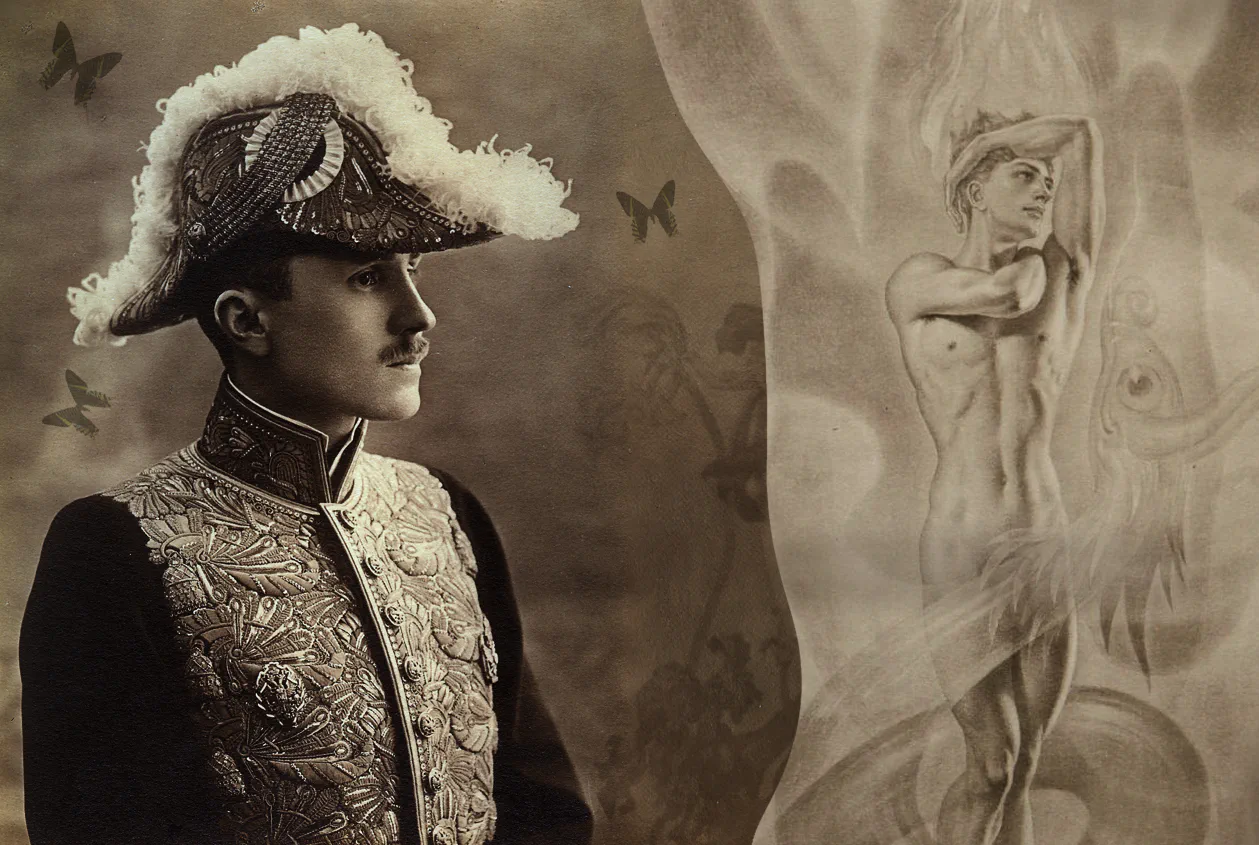
Andrey Nikolaievich Avinoff was a Russian artist, entomologist, museum professional, and a friend of sexologist Alfred Kinsey. He was a passionate collector, a connoisseur of beauty, and a gay man, yet he never made his sexual orientation public. In 1917, Avinoff emigrated from Russia to the United States. His homoerotic watercolors became known to the general public only in the 21st century.
A posthumous exhibition of his paintings in Pittsburgh in 1953 made no mention of this side of his life. In the homophobic climate of the United States at that time, the organizers deliberately concealed Avinoff’s identity.
That makes his legacy all the more significant — both the breadth of his interests and the complexity of his inner life. Avinoff was a gay artist and, at the same time, an Orthodox traditionalist who managed to achieve outstanding success in the intensely heteronormative world of American science.
This article explores the biography of the Russian émigré who painted butterflies, ballet, orchids, soap bubbles, and beautiful young men.
Origins, Childhood, and Early Interests
Andrey Nikolaievich Avinoff was born in 1884 in Tulchyn (now in Ukraine) into an aristocratic family. Family acquaintances later remembered him as a child with long golden curls, delicate facial features, and an exceptionally well-developed command of language.
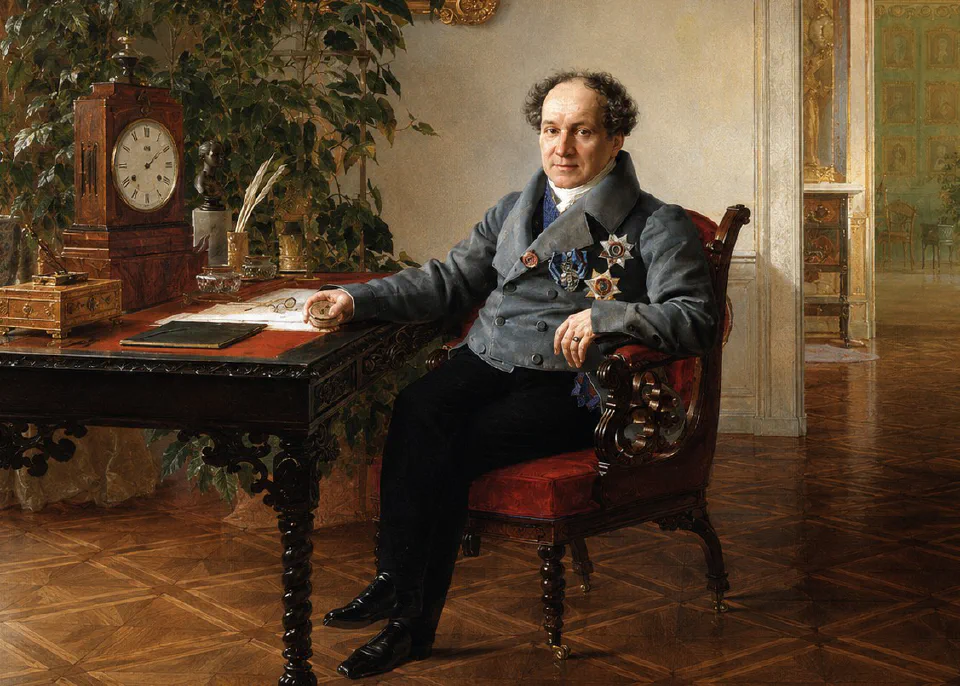
The family belonged to noble circles and traced its lineage to the ancient Novgorod boyar (high-ranking noble) family of the Ovinovs. Avinoff’s grandfather, Alexander, fought against Napoleon at Trafalgar (1805) on the side of the British fleet and rose to the rank of admiral. His maternal great-grandfather, Vladimir Panaev, was Minister of the Imperial Court under Nicholas I and helped shape the collections of the New Hermitage.
Avinoff’s father served as a lieutenant general. His older brother Nicholas later became a committed liberal reformer, while his sister Elizaveta became a successful artist, painting portraits of American millionaires and Franklin Roosevelt. A cosmopolitan upbringing and private tutors ensured the children had an impeccable command of English, French, and German.
“In a fine, elegant hand — his own calligraphy — he drew long charts, aligning his past with the period before the birth of Christ. He was absolutely certain that he was related to Cleopatra by indirect kinship…”
— Alex Shoumatoff. From “Russian Blood: A Family Chronicle” (1982)
According to a family legend, at the age of five Andrey caught his first butterfly, and by seven he was already reading the books of the American entomologist William Jacob Holland. Butterflies remained his main passion for the rest of his life.
Avinoff’s father was a gentle man. The children were loved, rarely forbidden anything, and supported in their interests (he taught Elizaveta to embroider in cross-stitch). From him, Andrey inherited a passion for collecting, a subtle sense of humor, and the habit of welcoming guests with attentive generosity.
In 1893, his father was appointed as a commanding officer in Tashkent. Nine-year-old Andrey traveled there with his family via Vladikavkaz, Tbilisi, Baku, and the Caspian Sea. In Tashkent, the Avinoffs befriended the Kerensky family and escaped the heat in the Chimgan Mountains, living in a yurt.
“That summer they suffered terribly from the heat. My father remembers how, as a child, he heard his grandmother and grandfather sitting in barrels of water in Tashkent and playing cards.”
— Alex Shoumatoff. From “Russian Blood: A Family Chronicle” (1982)
While collecting rare butterflies in Uzbekistan, Avinoff also painted them in watercolor. Because of congenital nearsightedness, he could discern the tiniest details of insect anatomy without the aid of instruments.
His mother could not endure the Tashkent climate. A year later, she returned to the family estate in Shideyevo, taking Andrey and his younger sister with her. Andrey settled in a church outbuilding. There, he flitted from one pursuit to another and quickly cluttered up the room, partly with shells from sunflower seeds, which he ate constantly. By then, his collection had grown noticeably and continued to expand with rare specimens.
He shared a warm relationship with his younger sister, Elizaveta. He taught her to draw and always helped her. In the winter of 1905, she sculpted a snow statue of Marie Antoinette in the garden, and 21-year-old Andrey made a figure of Voltaire beside it. Nicholas managed to photograph them, but at night the watchman smashed the figures with a shovel, mistaking them for burglars.
Education, Service, and Expeditions
In 1905, Avinoff graduated from the Faculty of Law at Moscow University and took a position in the Governing Senate as an assistant to the secretary general, where he reviewed the correspondence of suspected revolutionaries. In 1911, he was granted the title of Kammerjunker (Gentleman of the Bedchamber) at the court of Nicholas II; within the Diplomatic Corps, he served as master of ceremonies. This diplomatic experience, requiring exceptional tact and knowledge of etiquette, later helped him easily navigate the elite circles of American magnates. Meanwhile, Avinoff devoted his leaves to the study of butterflies.
An inheritance from his uncle enabled Avinoff to finance dozens of expeditions and personally embark on arduous journeys. The first expedition took place in 1908. During the second, in 1912, along with the entomologist Alexei Jacobson and the sportsman Mikhail Mamaev, he crossed the western slopes of the Himalayas — from India to Fergana via Ladakh, the Karakoram, and Chinese Turkestan.
His most famous discovery was a new butterfly species found in the Pamir Mountains in 1913. Avinoff named it Parnassius autocrator — “the Autocrat Apollo.” This name was chosen not only for the majestic appearance of the insect but also in honor of the 300th anniversary of the Romanov dynasty, underscoring the discoverer’s monarchist sympathies.
Avinoff returned from the expedition with a collection of eighty thousand specimens. It included about 90% of all butterfly species known at the time from Central Asia. In his Saint Petersburg apartment, cabinets filled with insects became part of the interior. Later, after the Revolution, the collection was confiscated by the communists and transferred to the Zoological Institute in Petrograd.
In 1913, Avinoff presented his collection and reported on his research findings at a meeting of the Entomological Society of London, speaking in flawless English. He received a gold medal from the Imperial Russian Geographical Society for a series of publications on Central Asian butterflies.
Two exhibitions featuring his work were held in Moscow alongside other artists. Avinoff showed both butterflies and mystical landscapes with a “Tibetan” mood; nearby hung abstract works by Kazimir Malevich and Wassily Kandinsky. That same year, he met the theatrical impresario Sergei Diaghilev.
Before World War I, Avinoff helped finance another 42 expeditions. By the age of thirty, he had assembled one of Europe’s largest butterfly collections and published seven articles on his discoveries in three languages. Such a broad scope of scientific and cultural interests made him one of the prototypes for Konstantin Godunov-Cherdyntsev — the legendary explorer of Central Asia and father of the protagonist in Vladimir Nabokov’s novel The Gift.
World War I and Emigration
With the outbreak of World War I, Avinoff was exempted from military service due to poor eyesight. He worked for the Zemstvo Union (a Russian organization assisting the sick and wounded) and tended to injured soldiers in Łódź, Poland.
In 1915, the Zemstvo Union sent him to New York on a diplomatic mission: to purchase medical supplies, ammunition, and military equipment for the Imperial Army. It was there that Avinoff saw a performance by Vaslav Nijinsky, met the dancer backstage, and later painted his portrait.
In 1916, Avinoff returned to Russia, but in the fall of 1917, shortly before the October Revolution, he departed for the United States once again. This time, he traveled east along the recently completed Trans-Siberian Railway, passed through Japan, and disembarked in San Francisco. Formally, he arrived as an official representative of the Provisional Government, in which his brother Nicholas served as Deputy Minister of Internal Affairs. Avinoff used this trip to emigrate.
While in New York during the Bolshevik takeover, he telegraphed his family, urging them to leave the country immediately. That winter, his mother, sister Elizaveta, and her husband Leo Shoumatoff managed to catch one of the last eastbound trains and made their way to the US.
Brother Nicholas remained in Russia. This decision proved fatal: in 1919, the family estate was destroyed, and Nicholas himself, a former liberal reformer, was shot by the secret police during Stalin’s Great Purge in 1937 after enduring multiple arrests. His wife, Maria, miraculously survived the repressions and occupation; she later emigrated and published her memoirs, Pilgrimage Through Hell (1968). The tragic contrast between Andrey’s successful integration in America and his brother’s death in Stalinist dungeons left a deep imprint on Avinoff’s subsequent life and art.
The artist himself managed to save only a few favorite butterfly specimens, a bundle of watercolors from his second expedition, and several paintings, including Cretan Motif (circa 1911–15). It depicts a supple, muscular nude man grappling with a giant snake; the shape of his cloak resembles the wing of an enormous butterfly. Crete was an imaginative site of homosexual utopia in the culture of the turn of the 20th century, which heightens the symbolism of the work.
Early Years in the US
Finding themselves in the US, Andrey and Elizaveta used their remaining funds to buy a dairy farm in Pine Bush, New York. The farm became a temporary refuge for Russian refugees: a ground-floor room with four beds turned into a dormitory. During the day, the newcomers worked in the vegetable garden, and in the evenings, they gathered for conversation.
Farming did not bring success. However, their proximity to the elite Yama Farms Inn resort in the Catskill Mountains, where Thomas Edison, Henry Ford, and John Rockefeller vacationed, played a crucial role in the family’s social rehabilitation. The club’s owner, Frank Seaman, recognized Andrey’s talent and helped him launch a career as a commercial illustrator. Soon, Elizaveta also found her calling, taking up portrait painting. Her husband, Leo, worked for Sikorsky’s aviation company and died in 1928 (he accidentally drowned).
Diplomatic skills saved him more than once. In 1919, Prince Georgy Lvov, the first head of the Provisional Government, invited Avinoff to serve as an interpreter at a meeting with President Woodrow Wilson in Washington, and later at the Paris Peace Conference, where the post-war global order was discussed. This proves that Avinoff was not an ordinary refugee — he continued to operate at the highest levels of international politics.
In the 1920s, capitalizing on American interest in Russian art (New York was already familiar with Léon Bakst, Boris Anisfeld, and Nicholas Roerich), Avinoff began earning a good living through advertising. In 1921, he held his first notable art exhibition.
In 1924, he won a prize at an advertising art exhibition for depicting Colgate-Palmolive soap against a backdrop of Himalayan peaks — a landscape from his own past. He also worked with the Underwood Typewriter Company, the building materials manufacturer Johns-Manville, and the automotive brand Chevrolet. In 1930, Avinoff designed the Winged S logo for Igor Sikorsky’s helicopters, a symbol still in use today.
“He is probably the only man who ever established — or tried to establish — a connection between butterflies and the Russian Revolution.”
— Geoffrey T. Hellman. From an article in The New Yorker, 1948
Return to Entomology and Museum Work
“At present, I have all but abandoned any hope of recovering this collection [of butterflies], and I have neither the courage nor the means to start a new one.”
— Andrey Avinoff
At first, preoccupied with survival, Avinoff devoted little time to butterflies. He was convinced to return to entomology by the French hawk-moth specialist Charles Oberthür, who framed it as a duty to science.
His reputation and connections with collector Benjamin Preston Clark proved helpful. In 1922, at an entomological conference, Avinoff reunited with William Jacob Holland, the director of the Carnegie Museum of Natural History in Pittsburgh and the Chancellor of the University of Pittsburgh. During this period, Andrew Carnegie generously funded science: archaeological excavations and the purchase of fossils and insects for the museum.
The Russian émigré made a favorable impression on Holland, who offered him a position as assistant curator of the entomology department. Initially, Avinoff declined, as illustration provided a higher income needed for his family, but he agreed in 1924. While sorting the museum’s collection, he soon identified 23 new species of butterflies. As a gesture of gratitude, Holland named the butterfly Erebia avinoffi after Avinoff, and Thanaos avinoffi after his grandfather, the admiral.
“His art was the art of high culture, as it was in Russia.”
— John Walker, Director of the National Gallery of Art (USA)
Following Holland’s retirement and the sudden death of his successor, Douglas Stewart, the board of trustees made a bold decision in 1926: they invited Avinoff to become the museum’s director. He held neither an American doctoral degree nor a diploma in management, but his cosmopolitan background, encyclopedic knowledge, and mastery of languages compensated for the lack of formal credentials. Avinoff accepted the offer and led the museum for the next nineteen years (1926–45).
During the Great Depression, he successfully balanced the budget, retained the staff, and funded 19 scientific research expeditions. Under his leadership, the museum made numerous acquisitions, the most famous being the purchase of a Tyrannosaurus holotype skeleton for $7,000 in 1941. Avinoff reformed the education system, introduced the creation of ecological dioramas, and was ahead of his time in his approach to popularizing science.
He divided his life according to a strict “five o’clock rule.” He explained to his nephew Nicholas Shoumatoff: “I worship the scientific fact until five o’clock in the evening. After that, I may have other ideas.” By day, he was a conservative scientist and administrator, and by night he transformed into a visionary artist whose paintings broke all the boundaries he himself established in museum classifications.
In 1927, Avinoff received an honorary doctoral degree from the University of Pittsburgh, and in 1928, he became a US citizen. He lectured on fine arts and biology, and also designed the “Russian Room” in the university’s “Nationality Rooms” — a classroom recreating traditional ethnic interiors.
The mass confiscation of property in Soviet Russia triggered a wave of sales in the West during the 1920s and 30s. Avinoff purchased Russian books on art, architecture, and history. Today, this valuable collection, which includes a unique facsimile of an illustrated medieval Apocalypse, is housed in the library of the Hillwood Estate.
“For a time I saw Dr. Avinoff at meetings and so on. I must say that he made a profound impression on me. […] I have never met anyone with such universal knowledge as he had. At every party I tried to figure him out, but I never could, because he really knew everything. Each time he would come out with an extraordinarily learned fact, or something you did not expect. He always did it respectfully, almost as if apologizing for his sharpness. It was very curious. Perhaps it is a Russian trait.”
— John Walker, Director of the National Gallery of Art (USA)
Between 1925 and 1940, Avinoff traveled to Jamaica six times, collecting about 14,000 butterflies (the collection is preserved in Pittsburgh). Wishing to “become an American,” he bought a Chevrolet to travel around the island, but he never learned to drive: his nephew was always at the wheel.
In the early 1930s, Avinoff reached an agreement with Soviet authorities to catalog his nationalized Russian collection. Batches of insects were sent to him from Leningrad for study. At the same time, he purchased entire collections for Pittsburgh.
In the realm of science, Avinoff made significant contributions to evolutionary biology. Together with the young curator Walter R. Sweadner, he studied butterflies of the genus Karanasa. Their monograph, The Karanasa Butterflies, A Study in Evolution (1951), became a milestone in the study of hybrid zone dynamics and geographic speciation. The scientists demonstrated that crossbreeding occurs where habitats overlap, blurring the strict boundaries between diverging species. In an era dominated by the concept of rigid species, such an understanding of biological fluidity was groundbreaking.
Avinoff served on the board of the American Association of Museums, headed the League of Nations Committee on Scientific Museums, and was a trustee of the American Museum of Natural History. From 1937 until his death, he corresponded with Vladimir Nabokov, and given their shared interests, almost certainly advised the writer during his work at Harvard University.
Simultaneously, Avinoff created two hundred full-color watercolors for Otto Emery Jennings’s botanical work Wild Flowers of Western Pennsylvania and the Upper Ohio Basin (1953). Illustrating plants in life size, the artist adhered to an ascetic code: he completely avoided using white paint (lead white) to create highlights, leaving the surface of the white paper untouched.
John Walker, Director of the National Gallery of Art, called him one of the greatest American artists to paint flowers and acquired two of Avinoff’s works for the gallery: Emergence (circa 1948) and Tulips (Disintegration) (circa 1949). In these late pieces, botanical precision gave way to surrealistic motifs of wilting and decay.
The Hann Icons and Soviet Art Export
Around 1935, aviation magnate George Hann, who was part of Avinoff’s gay circle of friends, acquired a massive collection of Russian icons. They were sold by the Soviet state agency “Antikvariat” (Antiquary), created to acquire foreign currency for industrialization. Avinoff compiled a catalog of this collection for an exhibition in 1944. He became a recognized authority on Old Russian art in the US: in July 1943, President Franklin Roosevelt even thanked him for information about icons presented by US ambassadors in the USSR.
In 1981, Soviet émigré restorer Vladimir Teteriatnikov published Icons and Fakes, declaring the entire Hann collection to be modernist forgeries fabricated by Silver Age artists for sale. Teteriatnikov accused Avinoff of creating a myth that legitimized the fakes. This severely damaged the entomologist’s reputation as an expert.
However, modern research (by Maria Taroutina, Wendy Salmond, and Kristen Chaves) categorically rejects this conspiracy theory. The Hann icons turned out to be authentic late works (19th — early 20th century) or old panels subjected to aggressive restoration in Old Believer workshops. Soviet sellers deliberately falsified documents and inflated the age of the paintings to sell them at higher prices to naive Americans. During attribution, Avinoff had to rely on these fabricated papers and book reproductions, lacking the means to conduct chemical and technological expertise. Thus, he became a victim of the Soviet state’s cynical marketing strategy, rather than a co-conspirator in deceit.
Avinoff’s hopes for collaboration among museums worldwide collapsed with the outbreak of World War II. He was also among the prominent individuals who signed protests against the Soviet invasion of Finland in 1939.
“I consider Avinoff one of the greatest people in the world. He and his sister arrived in this country with nothing and became two of its most outstanding citizens. I am proud of America because this happened. And I am proud of them.”
— Archibald Roosevelt, son of President Theodore Roosevelt and a friend of the Avinoffs
Later Years: New York, Intensive Painting, and Death
In 1945, following a heart attack, Avinoff retired from the museum and moved into his sister’s mansion in Locust Valley on Long Island. In 1948, he persuaded Elizaveta to move with him to Manhattan, where they rented adjacent luxury apartments on Fifth Avenue.
Freed from institutional constraints, Avinoff took up painting professionally. He painted still lifes, surrealist landscapes, and botanical illustrations. Over four years, despite his failing health, he created more than two hundred compositions and was the subject of eleven solo exhibitions. Life magazine planned to feature him on the cover of its fall 1949 issue.
“The best way to understand the nature and soul of the Russian people is through a sympathetic study of their creative endeavors as expressed in painting, architecture, literature, and music.”
— Andrey Avinoff. From the introduction to an exhibition catalog of Russian art, 1943
By his own admission, Avinoff held right-wing political views. He shared antisemitic prejudices common among conservatives of the Russian Empire; some of his Jewish colleagues in Pittsburgh remembered this.
Avinoff was deeply religious. Throughout his life, he firmly adhered to Russian Orthodoxy and recognized a mystical inclination within himself, which led to themes with excessive symbolism.
Despite his outward traditionalism, he proved to be a thoroughly modern man: he easily embraced capitalism and democratic citizenship. Unlike many White émigrés, he took almost no part in futile campaigns to overthrow the Bolshevik regime, attempting instead to preserve and root the best that Russian culture could offer Western civilization in his new homeland.
Andrey Avinoff died on July 16, 1949. His last words were: “The air — how pure it is.” Two days later, he was buried at a Russian Orthodox church. An epitaph is carved on his tombstone at Locust Valley Cemetery on Long Island: “BEAUTY WILL SAVE THE WORLD”.
“It seemed as if the scent of a rose came from the tip of my brush as I painted. I became the rose.”
— Andrey Avinoff
▶️ A Former Student’s Recollections of Avinoff (in English) (YouTube)
Homosexuality, Homoerotic Art, and Kinsey
A key author in Avinoff’s sexual and intellectual evolution was the Viennese thinker Otto Weininger. His book Geschlecht und Charakter (Sex and Character) was published in German in 1903 and became a scandalous bestseller. It was known within the family: his brother’s wife, Maria, quoted Weininger’s idea that both male and female genes are present in every person.
In Russia, Avinoff regularly visited bathhouses. In a conversation with Kinsey, he described St. Petersburg bathhouses with private rooms, where young masseurs aged sixteen to twenty were “always available” and eagerly serviced clients.
In the US, Avinoff had to adapt to a more homophobic and puritanical cultural environment than in the bohemian St. Petersburg of the Silver Age. For example, publishers rejected his cover sketch for the magazine The Machinist, considering it “too much of a display of male charms.”
Director Holland of the Carnegie Museum was known for his homophobia, and the son of Avinoff’s patron Preston Clark committed suicide in 1930, unable to withstand social pressure. In the 1930s and 40s, institutional homophobia in the US was only growing stronger.
Avinoff never flaunted his sexual orientation. The Pittsburgh establishment knew him as a lifelong bachelor. Nevertheless, he entered a highly exclusive elite homosexual circle, which included the heir to the Alcoa aluminum empire Roy Hunt, aviation magnate George Hann, and the future curator of the Museum of Modern Art (MoMA) in New York, Edgar Kaufmann Jr.
In this protective bubble of wealth and privilege, his homosexuality was simply perceived as an extravagant trait. Contemporaries described his appearance in Pittsburgh society as “the arrival of a fairy-tale creature from another planet.” At one social event, he appeared in a butterfly costume, to which the press responded with a thinly veiled caricature in the Pittsburgh Post-Gazette.
“For him, art was a reflection of nature. Dr. Avinoff’s genius [encompasses] the full spectrum of human experience. […] Like the masters of the Renaissance, he was, in many ways, a consummate and outstanding scientist, artist, museum professional, mystic, and friend to many.”
— Walter Read Hovey, Chair of the Department of Fine Arts, University of Pittsburgh
Avinoff led a secretive life and created a large body of homoerotic art. His romantic relationships were apparently unstable, unequal, and short-lived. In addition to butterflies and flowers, he depicted nude youths, angels, demons, and ghosts. After his heart attack in 1945, the artist destroyed most of his explicit works: he “did not want to leave such things behind for his sister.” Later, he referred to this act as his “holocaust.”
One of Avinoff’s most famous series of illustrations was created for the epic poem The Fall of Atlantis (written in 1935–38) by the Russian émigré George V. Golokhvastoff. In 1944, Avinoff released them as a separate limited edition in the form of photogravures. Originally, they were executed using charcoal, chalk, brush, pen, spatter, and scratching on paper. The drawings are layered in symbolism: the winged male “spirits” and angels that populate them serve as a metaphor for the rise and fall of civilizations, as well as a manifestation of deep homoerotic desire.
His interest in sexuality led Avinoff to a friendship with researcher Alfred Kinsey. Both scientists started out in entomology (Kinsey studied gall wasps) and applied the principles of strict biological taxonomy to the study of human behavior. In January 1948, Kinsey published the groundbreaking study Sexual Behavior in the Human Male. Having learned about the upcoming book in late 1947, Avinoff broke his years of silence: he wrote a letter to the author, introducing himself as a “fellow entomologist,” and disclosed his sexual orientation.
“Allow me to introduce myself. I am a fellow entomologist… I read about your forthcoming book in the latest issue for ’47, and I am very interested to know when it will appear… My observations of the artistic and theatrical world of Old Russia – including poets and writers – have led me to wonder whether there may be certain parallels with conditions in this country. I hope you will excuse this letter from a stranger.”
— Andrey Avinoff. From a letter to Alfred Kinsey, December 14, 1947
A close friendship formed between them. Avinoff became an active participant in the work of the newly established Institute for Sex Research. He contributed materials about his sexual biography, over six hundred explicit drawings, and introduced Kinsey to New York’s LGBT bohemia.
Avinoff dreamed of creating an elite male club with private rooms decorated with frescoes depicting beautiful youths. He named this project APOCATL; the origin of the word is unknown. According to the plan, senior members of the club were to find and induct promising young candidates. Sketches of the frescoes for APOCATL have been preserved at the Kinsey Institute.
“Fair-haired young men – who were Andre’s ideal of both spirituality and sexuality – recalled the biblical description of angels as beings both spiritual and beautiful.”
— Paul Gebhard, an associate of Kinsey
In the 1930s and 40s, Avinoff frequently attended life drawing classes at the Carnegie Institute of Technology. At the same time, free drawing lessons at the Carnegie Museum were attended by the teenager Andy Warhol (then still Andrew Warhola), who came from a poor family of Carpatho-Rusyn immigrants. Avinoff served as a judge for the Scholastic art competition, where young Warhol won one of his first awards. Later, Warhol enrolled in the institute’s design department, and they once again found themselves in the same socio-cultural space.
Avinoff often found models for his erotic drawings among the students. By the middle of Warhol’s studies, Avinoff’s soft homoerotica was actively circulating in the student community. Art historian Blake Gopnik notes striking similarities: both artists built visual narratives around images of butterflies (symbols of metamorphosis) and phallic symbols. Edgar Kaufmann Jr. from Avinoff’s Pittsburgh circle later helped young Warhol secure his first commissions in New York. Thus, Avinoff became a crucial link, transferring the refined LGBT aesthetics of the Russian Silver Age (a period of exceptional creativity in Russian arts and literature at the beginning of the 20th century) to industrial Pittsburgh, where it influenced the formation of the early pop art style.
In 2005, the Kinsey Institute held the exhibition “Beyond Russia: Chagall, Tchelitchew, Avinoff” (Out of Russia), presenting Avinoff’s erotic drawings to the general public for the first time.
Gallery
Impeccable manners, an aristocratic bearing, and self-deprecating humor in Andrey Avinoff went hand in hand with an enormous capacity for work. Formally, he could be classified as an illustrator, but his works are dedicated to themes he took extremely seriously: a mystical sense of the connection between nature, life, and spirit. His obsession with going above and beyond, as well as his aesthetics, were intertwined with this.
“Avinoff should rightly be regarded as one of the most important surviving artists of Russia’s Silver Age (a period of exceptional creativity in Russian arts and literature at the beginning of the 20th century) to have made it to the United States. He not only embodied the ideals and practices of the Silver Age in his life and work, but also passed them on to the next generation of New York artists and intellectuals, who would transform the city into the next great center of international modernist culture.”
— Louise Lippincott, Carnegie Museum of Art
References and Sources
- Avinoff, Andrey, and Walter R. Sweadner. The Karanasa Butterflies, A Study in Evolution. Pittsburgh: Carnegie Museum, 1951.
- Gopnik, Blake. Warhol. New York: Ecco, 2020.
- Jennings, Otto E. Wild Flowers of Western Pennsylvania and the Upper Ohio Basin. Pittsburgh: University of Pittsburgh Press, 1953.
- Lippincott, Louise. Andrey Avinoff: In Pursuit of Beauty. Pittsburgh: Carnegie Museum of Art, 2011.
- Salmond, Wendy. “Russian Icons and American Money, 1928-1938.” In Collecting Old Icons. Russian and Greek Icons 15th-19th centuries, edited by Simon Morsink. Amsterdam: Snoeck, 2011.
- Shoumatoff, Alex. Russian Blood: A Family Chronicle. New York: Coward, McCann & Geoghegan, 1982.
- Shoumatoff, Nicholas. Andrey Avinoff Remembered.
- Teteriatnikov, Vladimir. Icons and Fakes. New York: Teteriatnikov Art Expertise, 1981.